
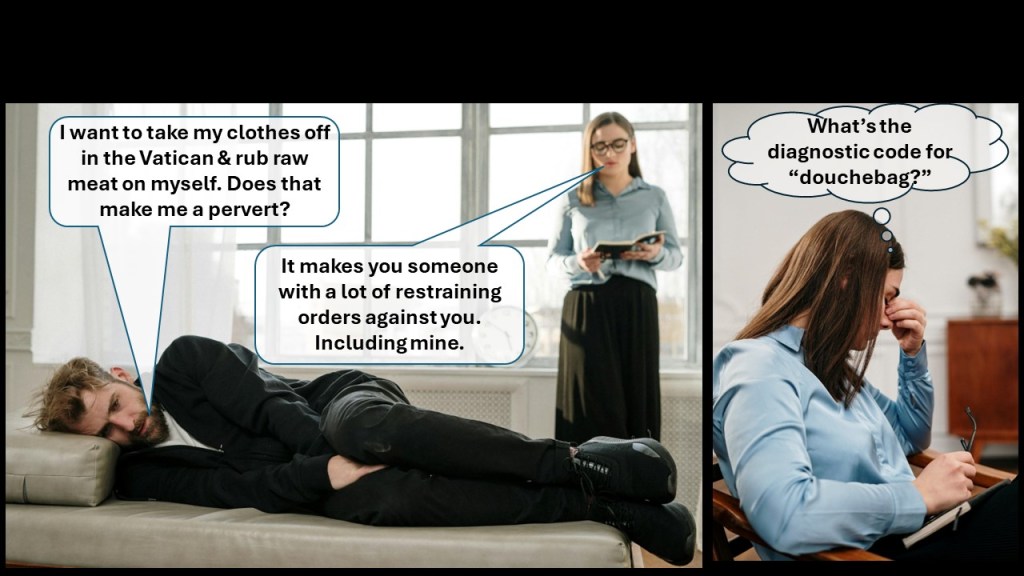
Diane, my dedicated psychiatrist, endured my recollection of Sweden, which lasted the entirety of the previous week’s session. During this session, I had a corporate meeting the next day and had planned to talk to her about ways to avoid going.
Her first words surprised me. “You were in love. Wait. Hold on. Not with her. The concept. The exemplary Jen. The righteous woman. There are righteous men, too.”
“I haven’t met any.”
“Neither have I.” She half-smiled. Her hubby, at her insistence, recently moved out. He was living with the woman he had been having it off with for the past year. “You fixated on her. You remember the upright ones. Did you want to die for her?”
I laughed. “Well, let’s not go overboard. I was willing to protect her, but…”
“Wrong.”
“I hate you.”
“Of course you do.” It was a running joke between us. “Die for her. Find redemption. You’d be Gandhi. Or, Joan of Arc. Not burned at the stake. That’s not your style. You wouldn’t have to be the person you thought you were.”
“When we left Sweden, yes. I would have eaten the bullet for her.”
“You’d die for her. Perhaps you were falling in love.”
I was ambivalent about that subject. I tended to doubt it.
Diane continued. “You wanted to know her better. You made time for her. A lot of it. All of it. Protective, empathetic, intrigued, and, well, possessive. Did your hormones go wild?”
I acknowledged her assessment. “No. I was too sober for the hormones to do much. I was gaga about her better qualities.”
Diane glanced at the ceiling for a moment. “She was another jackass on the bus. Nothing more. Jen was more charitable than most but capable of the same terrible things you were. Her dark side was no lighter than yours. Or mine. Or the rest of us slobs. She tried to poison her father. Her poop stank as much as yours.”
I laughed. “I never verified that. It may have. I could have stood over her and had a sniff. That was a level of intimacy I was thrilled to live without.”
“Good. Otherwise, we’d have to change your medication.”
Diane asked me a question that came from left field. It also showed some of her insight:
“Dreams. Dreams, dreams, dreams. What dreams did you have after your last time together? Any that you remember?”
I replied, “You know me well. This is disconcerting. As I’m sure you expected, the answer is ‘yes.’ A vivid one. I may have mentioned this one to you. It’s a recurring one. This time, it ran to a conclusion. Go figure.”
“About walking back in time. That one?”
I gave her a deadpan glare. “I hate you more.”
Diane laughed out loud—a rare moment for her. “Good. I’m winning. This dream has always left you hanging. Tell me about it. All of it. I’ll get my popcorn. This is important.”
“This is important” was never something she said lightly, and the expectation was to discuss the subject sans silliness and snappy banter.
At her direction, I described the dream. To her unending credit, she never interrupted with clarifying questions or comments:
In this dream, I walked through my life in reverse chronological order. I started today in a village and kept walking through my past. It was silent, and I was alone. No cars, no people. Only me. It was sunny, the grass was green, and the road was newly paved. Trees were everywhere, and they were magnificent. The houses were modest and well cared for. The whole place was clean. And nothing was out of place.
The only sound I heard was of me breathing as I walked. I was alone but not lonely. The warmth of humankind was intense. My wife, friends, and co-workers from my most recent job appeared. They smiled and waved. I was happy to see them. No one spoke. No one needed to.
A block ahead of me were two people. As I got closer, I recognized them. A couple of coworkers at an earlier employer from 25 years ago. Two people with whom I shared mutual disdain. They weren’t moving. As I walked closer, I saw them glaring at me. I got within 10 yards of them, stopped, and said, “Well, uh, hello. Yes, right. And, how’ve you both been?”
The only reply I got was their angry stares.
I always found them annoying, and this was no exception. “Oh, me? I’m doing fine. Thanks so much for asking.”
Still nothing.
“Well, listen. It’s been thrilling speaking with you, your limited vocabulary notwithstanding. No, I must be going. I have to go…flush the radiator. Yeah, it’s urgent. You know how that goes. Cheers.”
I walked past them. After a hundred yards, I saw them still standing and staring.
Clouds were interrupting the warm sunlight. It felt like I was in the 1990s.
After walking another block, I came across an old girlfriend. After our unpleasant breakup, started by me, she stalked me and even threatened bodily harm if I didn’t take her back. I always wondered what her thought process was with that strategy.
Next to her were two other women I had cast aside in earlier lifetimes. I gave them a nod of recognition. They glared at me. I kept walking and, appropriately in their cases, never looked back.
At this point, it was overcast. The wind was beginning to pick up. The houses weren’t lovely and tidy anymore. The vibrant color at the beginning was now getting gray. I walked towards eight or nine people standing together with their arms crossed. They died when I was in my mid-to-late 20s. I was walking through the 1980s. I was close with some of them. I wanted to run over and hug them, but I didn’t. They looked furious. I didn’t stop to say anything.
I felt uncomfortable and very guilty. I picked up the pace. It was getting darker and colder. As I walked back in time, those houses and buildings were decaying quickly. The road was breaking apart. The warmth of the day was gone. The grass was brown, and the trees were bent over. Only a few leaves remained. There was almost no color at all.
There were plenty of people I knew from the 1980s. They stood on either side of me as I continued walking. They were those I left behind. The friends who died, the people I discarded or who discarded me. They stood and looked at me with indignance in their eyes.
I stopped. I didn’t want to walk further. I wanted to go back to where it was sunny and warm. I turned around. All the people and places I walked past disappeared. All gone. Instead, there was a massive wall of garbage directly behind me. It was impossible to go back.
I stood in the cold darkness. I was unable to escape. I had to keep walking, but that was becoming difficult. The ground was cluttered with debris, potholes, and broken pavement. There were now hundreds of people surrounding me. I had to sidestep them as I continued. They still said nothing. I felt their rage.
I walked past the colleges I attended in the 1970s. The friends and teammates I left behind stood and dismissively watched me stumble. The sides of buildings on the campus were missing. Houses looked as though they were beginning to cave in. I walked faster. My old high school was to my right. It was dark. It looked like someone had torched the place. All my old classmates stood around the shell of the building. I tried running but kept falling. I saw my elementary school. It was reduced to rubble. The teachers stood there. My fourth, fifth, and sixth-grade teachers stood closest to me. In school, they made it their mission to remind me, as often as possible, that I was too stupid to succeed at anything.
I was exhausted and thirsty. My legs were tired, and I wanted this to end. I thought about giving up. Instead, I kept running until I entered a clearing. With my hands on my knees and gasping for air, I stopped and saw my childhood home to my left. It was barely standing. The windows were broken, half of the roof had collapsed, and debris surrounded the house. The adults who, on separate occasions, beat me half to death stood on the front lawn. I recognized them at once. Thousands of corpses were in a pile behind me. I looked ahead and saw nothing except blackness.
It’s at this point when I usually wake up. This time, I continued dreaming.
I turned to my run-down and battered childhood home. The front screen door opened, and Ken appeared. Ken died under suspicious circumstances when we were seven. He was my best friend. His mother was behind him, partly obscured by the screen door.
When we were children, I only saw Ken’s mother once. She had bruises on her face. Other than that, she was a voice behind a screen door. Ken never talked about his life at home, and even though I was only seven, I knew enough not to ask.
Ken walked towards me. He still looked and sounded seven years old. He had on his favorite sweatshirt. Blood was all over it. He came closer. His eyes were jet black. There was a messy bullet hole in his forehead. He stopped four feet before me and looked at me for a long time before speaking. He looked bemused.
“What the hell are YOU doing here, you leper?”
He tilted his head and smiled.
“Nice to see you, too,” I replied. We stood motionless and stared at each other.
Ken half-laughed and said, somewhat aggressively, “So, persona non grata number-one decided to visit the crime scene. Are you checking property values?”
“Ken, I have no idea why I’m here. Not clue-one.”
Ken escalated the aggression. “Yeah, right. That’s why you ran here. Since there’s no point in showing up, may I interest you in a dame de la nuit. I got a dozen of them ’round back. Take two, they’re small. Maybe you feel like getting your head kicked in some more. I’ll find hundreds of people willing to help with that. I….”
“Why the hell are you talking like this?”
He snapped back, “Why the hell are you here?!”
I shrugged.
“Did you stumble all this way with a purpose, or have you simply lost the plot entirely? Out with it! Why…are…you… here?”
“I don’t fucking know! I can’t exactly turn back, what with the big pile of stiffs behind me. I should have kept running.”
Ken looked puzzled. “But, you didn’t keep running. You stopped. Right here. Of all places. Why didn’t you run when you saw this place or me? I would’ve. I’d be gone already. So?”
I glanced back to the bodies and wreckage behind me. I looked at what remained of my childhood home.
“Ya know, Ken. Have you ever considered doing a little makeover on the old homestead there? Not to be critical, but this place looks like….”
“You staggered here to tell me this dump won’t make the cut for Better Homes and Gardens? Your loose grasp of the obvious has always been your sole strong suit. Mother, for once and for all, may I go back inside and die for good, please?”
Ken turned around and started walking back to the house.
I wasn’t prepared to end the conversation. I didn’t want Ken to die for good. “I can help you with your little fixer-upper. Especially with the fixer part.”
Ken stopped and slowly turned around. I got the bemused look again. “Fix it? You wanna fix it?” He paused, smiled, and walked directly to me. Once he was a foot in front of me, he asked, “Did you come all this way to fix things around here?”
His eyes didn’t deviate from me. I said, “Well, no. I was just…”
“Well, YES! That’s exactly why you came back here! It took you long enough to admit it.”
My unclever retort was, “Uh.”
Ken turned to the house. “It could use some fixing, no doubt. Do you think you can fix all this? Things did get pretty bad here.”
“I, uh. I don’t think that’s why…”
“Good. Where do we start? We need to drop all this garbage once and for all.” He looked anxious to start. “All the clutter needs to leave. How about everything that went wrong? That’s gone, too, right?”
“Uh…..”
“The pain? The hurt? Would you be able to get all that out? I mean, you came here for a reason.” We stood shoulder-to-shoulder. He sounded excited.
“Ken, I don’t quite know what you’re…..”
Ken barged ahead. “Oh, and the shame. Let’s fix that. Fact’s a fact. You came here to fix this whole thing. I know it. You don’t want to say it.”
“I think you’re making more of this than there is. I mean, well, I…”
“Stop. Did you come all this way to exchange recipes? No. No way. You are here to fix things that have been broken for a very…very long time. And, you know it. Took you long enough. Hell, you’ve been wanting to fix everything here for decades.” I stood staring at the house while Ken escalated his enthusiasm. “Finally! You’re here! Right here, right now. It’s time to get to work and get this taken care of. You know what you need…”
“I don’t know where to start.”
“Start at the beginning. Start in the middle. Who cares? Get in. Fix the whole place, and you can walk away forever. No more guilt. No more pain. No more memories. Gone. Self-hate? Gone. Depression? Gone. Let’s go!”
I casually responded, “Okay. Deal. You win. We’ll do this thing. Fix it. Make it right.”
“Great. Let’s roll. If we’re gonna fix all this, there is no time like the present. To make it right, you said. Well, good. Oh, one small thing about fixing this and making it right.”
“What’s that?” I asked.
Ken turned to me. “You can’t.”
After a loud silence, he shot me a big grin and turned around.
I watched as he slowly walked back into the house. The adults in the yard were gone. His mother opened the door to let Ken in. Before he walked in, he turned to me, winked, and said, “See you down the road.”
“Or not,” I replied. I decided it was okay to let Ken die. This time, at least, it would be on his terms.
After Ken had walked into the house, his mother opened the screen door and stepped out. She stood before me. Before going inside, she smiled and waved goodbye. There were no bruises on her face.
I looked back. The bodies were gone. I turned to look at the house again. It was also gone. I looked ahead and saw a road.
Nothing but a road.
I started walking.
Then, I woke up.
Diane surveyed the half-distance as if to resolve her mental contortions. “Well. Was Jen the catalyst that freed you from a few of your past lives? The path at the end of your dream may have been a product of her influence. Perhaps Ken was Jen. One allowed you to leave behind the things you can’t change. It may be that they both did. She didn’t care how you arrived in her life—no more than you cared how she arrived in yours. You didn’t think you needed to apologize. For anything. Is that why you felt the attachment? It’s not a leading question even though it is.”
I gazed into the same half-distance. “I think so. Yes. Her presence. I lost the desire to please everyone, all the time, every day, and twice on Sunday, to make up for all my misdeeds, especially the ones I never committed. I didn’t feel ashamed. She simplified…no, I simplified some of the elaborate quadratic equations in my psyche.”
Diane agreed. “Last week, you told me the same thing about her. More than once. Her goal was simple. I guess the path there was simple, but it was treacherous. You admired her for trying. Even if her poop stank.”
I took a minute before responding. “Her passion was to be close to God. As close as humanly possible. I’m not sure if that’s a lofty goal. I don’t know. In her mind, the steps were easy to understand. She did her best to execute those steps. To her last day, she never allowed my polished and urbane cynicism to replace her unrefined gullibility. That must not have been easy. She was untainted by the evil inflicted on her. And, yes, remembering her diet, her poop must have been ghastly. Again, it was an activity I chose not to monitor. However, outside of her bathroom habits, I followed her example. My goal is to be a better me. You know. Better friend. Better hubby…”
“Have you ever seen someone laughing all the way to the bank?” She paused. “Remember, all Jen’s layers were not wholesome. She had just as many repulsive ones as you and me. They were just as pungent, too. The human condition is mangled. I guess a Christian would say we’re broken because of it. A psychiatrist would say simplifying all the mangled wreckage is part of life’s rich pageant.”
“Did you ever pay through the nose for anything?” We chuckled. “She’s off the pedestal. She was no better than me. I know that. Now. Don’t psychiatrists also say half the global population suffers from penis envy?”
Looking quite serious, Diane said, “There was an investigation completed recently. The study group included all of the US citizens. The results revealed the only person afflicted with penis envy is my ex-husband.”
“A monkey in silk is still just a monkey.”
She looked startled. “What on earth does that mean?”
“No fucking clue.”
“Perhaps we should review your medications.”
“May I leave now?”
Diane maintained her natural analytical tone while asking her favorite question. “What was the most important lesson from your Sweden visit? One sentence. A demerit for two sentences.”
It took almost a minute before I replied. “Cold indifference, dignified contempt, and unrelenting self-hatred, diabolical though they may be, will lose to raw, undiluted hope, faith and love. May I expand?”
“For a fee.”
I said, with a sense of relief, “It’s a hell of a lot easier when it’s not all about me.”
“Good. Now. The party. The one you are supposed to attend tomorrow. The one you’re trying to weasel your way out of. Don’t look like that. You will attend. Yes, you will. For sixty minutes. No less. You will talk with some of them, and you will not forget that half of them have below-average intelligence. Their layers are no better than yours. They don’t know more than you. They masturbate. A lot. Trust me, they do. Most of the men watch porn late at night. Twenty percent of them beat a family member. A third of them are cheating on their S.O. They’re all self-absorbed liars. They’ve all had their traumas. All of them have twelve wonderful excuses for doing the wrong thing. They smell their farts for fun. You’re not them, thank God. While they wasted their twenties getting bogus master’s degrees and snaking their way up corporate ladders, you traveled the world. Tell them. They’ll be so jealous. Your assignment is to mix with the little losers. I expect a full report next week.”
“Yes, mother.”
“You’re getting closer to that version of you. You can call me after the party. If you want.”
I left feeling fully armed to take on the C-Level deadbeats the following day.
—THE END—


 BOOMER(S) GONE WILD!
Leave a comment