

—CHAPTER FIVE—
We woke up late the following morning. Emi felt the previous evening had been loads of fun and, to Emi’s mind, highly instructive. My memory of it was cloudy, as was my hangover. I didn’t mind.
I guess I was decent in bed. Good old Jack and Coke do keep the ghosts at bay. I wish I could enjoy these things while sober.
Something must have gone drastically right because my legs buckled when I stepped out of bed. My back was killing me. I noticed a bruise of unknown origin on my arm. Then, there was the issue with my head. I couldn’t turn it in any direction without experiencing resounding pain in the back of my neck. My eyelids hurt. I slowly turned to Emi and assessed her current condition.
She appeared unscathed. So that was good.
The first item on the agenda was to find another hotel for the rest of the week. We packed and stumbled to the lobby, where we saw our hero, Miho. I felt we owed Miho something for the effort but had no idea what that should be. Miho made a couple of phone calls before returning.
Emi turned to me. “Grandfather has found an inn where we can stay. He is kind and generous. It is approximately eight blocks from here. Would you care to walk to the new location?”
“Yeah, right. Let’s take a cab, shall we?” Walking to the lobby was all I could do. “Is there anything we can do to express our gratitude?”
“I offered this. She prefers we not do this.”
More back-and-forth between Emi and Miho. Emi turned to leave.
I stood in front of Miho. With my hands in a praying position, I bowed slowly and said, “Arigatō gozaimasu. Anata wa totemo shinset sudeshita. I hope I got that right.”
She grinned. “You’re welcome. I can’t wait for that piece of shit to come here so I can laugh at him when he finds out you’re not here. Fuck him.”
“Very well said.” I turned to Emi and whispered, “I like her.”
The new place was stunning.
Water flowed down the walkway from the front door. I found this worrisome. “Are the toilets backed up again?”
Emi laughed. “This is good for them to do this. It is traditional to welcome guests with water in this way. It is important to remember to remove your shoes at once upon entering. It is disrespectful not to do this. They know you are American and, therefore, will expect you to disregard this custom.”
“Can’t say that I blame them.”
“Please place the suitcases here.”
The “ladies first” concept hadn’t reached Japan in 1983. I opened the door for Emi, and she hesitated. The form was for the man to enter first and let the poor woman stagger in last to confirm her inferior status. I entered and took off my shoes. I put my size thirteen feet into the inn’s size eight slippers.
We were met by four people who all smiled, bowed a few times while saying something in Japanese, and stared at me, awaiting a suitable response, which was unnerving. The interior was beyond description other than to say it was beautiful.
I bowed and did my best. “Konnichiwa. Uh, watashi wa zannenna…hitotoshite. Nihonjin, uh, uh…wa watashi ni tsuite hanashimasen.” I glanced at Emi. “Kanojo wa Nippon o yarimasu.”
What I meant to say was, “Good afternoon. I am sorry. I do not speak Japanese.” And, after a pause to acknowledge Emi, “She speaks Japanese.”
What I really said was, “Good afternoon. I am unfortunate…as a person. Japanese…I sum two follows don’t want to talk about it. She sum Japan oh I’ll do it.”
All four bowed and said, “Ahhh.” As if I made any fucking sense at all.
I shrugged, gave a sheepish grin, glanced at Emi, and said, “Watashi wa tameshita.” I think this means, “I tried to speak and failed.”
They bowed more and, almost in unison, said, “Ah, ah. Arigatō gozaimasu!”
I glanced at Emi. “You wanna help me out here? I’m digging a hole, and the dirt’s landing on me. Please. I’m running this up the flag pole, and they ain’t saluting.” Pause. “You just want to see me sweat. You may want to intervene before I cause World War III.”
Emi took charge and managed the transaction. She gave me occasional translations. Conducting business in Japan means complimenting each other until no one can stand it anymore. We were given a tour and led to the room with enough courtesy to make you want to puke. We had to take the slippers off before entering the room. More bowing and thanking. They left.
The room was pristine, of course. There was handmade artwork, including stained glass. Again, it defied description. The window screens were raised to the precise level against the window. The room dividers were just at the edges of the walls. Nothing was out of place. The degree to which everything had been polished was staggering. I was afraid to touch anything.
Hell, the bathroom would have made it worth the price of admission. Or, to quote the drill sergeant in Full Metal Jacket, the Virgin Mary herself would have been proud to take a dump in it.
Over the past week, I came to believe that Japan has a neat but shallow facade that masks some unpleasant infrastructure. If that was the case, then this inn was the exception to that rule. It felt like the real deal.
Emi and I cleaned up and toddled off to the room where we would experience a traditional tea ceremony. As we walked, Emi apologetically said, “While we are here, we must not be intimate. The innkeepers understand it this way. To do otherwise would be disrespectful. I am sorry. I hope this is not problematic for you.”
“Don’t apologize. That’s my job. It’s not problematic at all. I’m always respectful. You know that.”
“Yes. Yes. You are most kind to do this.”
“Emi, may I inflict you with a life lesson?” She nodded. “Expect respect. Don’t request it. You can thank someone for showing you respect. People appreciate that. I do. But, if someone doesn’t show you the same respect you show that person, then drop him or her down a deep hole. If you must ask a person to be respectful, walk away. If you want a relationship with someone who does not respect you, you can say, ’If you show one more sign of disrespect, then it’s over.’ If he argues, then tell him the door’s right there. You deserved your father’s respect, and he failed. You did the right thing and left him to twist in the wind.
“Forgive me if I’m overstepping. Respect and kindness should be an unspoken requirement. Your father showed you neither. So, you thought you didn’t deserve them. Thou shalt no letteth anyone hurteth thee. One of the more devastating moments in my life was when you thanked me for not hurting you.
“In your brave new world, respect and kindness from others aren’t nice things to have. They are baseline requirements for everyone. Boss, subordinate, co-worker, family member, friend, lover, acquaintance, or any-fucking-body. Fair?”
She thought those were fair statements.
Aren’t I so clever? Wise and learned? Too bad I can’t take my advice and apply it…to me. Probably sheer cowardice on my part. Unquestionably. I’ll keep dumping my great insights on everyone else. Talk about veneer covering up all the ugly parts. Well, that’s me. No wonder I feel so comfortable here.
I am such a disgrace.
I wonder if Emi can see through me. Why can’t I tell? She’ll discover soon enough. She will know.
Why?
Because a loser is a loser.
The tea ceremony was quaint and simple. Most observances and traditional acts in Japan are simple. It could be out of necessity because so many complexities remain unspoken in every action. Complicated feelings are repressed, insecurities run in all directions, and the large knot supporting the spirit behind these customs gets tighter.
In Tokyo, there was a palpable impression of disconnectedness among folks. I wondered if this created more unresolved confusion, suspicion, and conflict. It was less so in Kyoto but not by much.
Of course, the loneliest place is sometimes in a large crowd of people with whom you have no honest relationship. Japan’s government established a Ministry of Loneliness for a reason. From where I stood at the time, Japan’s urban areas were swarming with isolated people juggling a few thousand contradictory and convoluted feelings that further pulled them apart.
To make matters less appealing, there was the obsessive pursuit of anonymity. That was another impression I had. Adults dressed, appeared, spoke, and acted the same. If the eighteen-hour workdays didn’t kill them, the peer pressure to be invisible would.
And, just to fuck things up even further, there was a gargantuan weight of expectation on all Japanese folks to be perfect.
Japan is not the land of second chances. If you live in Japan and screw up, then move out of the country. Canada’s nice. Go there. Don’t stick around because you are done. There is no way around this. Your humble apologies will be accepted. That part is fine. Will your sins be forgiven and forgotten? That part is not fine. Forgiveness is not happening. Therefore, don’t hold your breath on anyone forgetting a single detail. You can seek refuge in the love and support of your family. The challenge here is that thanks to your indiscretion, you make your family sick, and they are the last place you want to go, as you have dishonored the family name forever.
What did you do to bring this on yourself? Suppose you were in the States with a full-time job being a mass murderer and were caught. In that case, your family might remove your pictures from the wall. Also, you’d be sentenced to thirty years in the electric chair. After eight decades of appeals and legal maneuvering, you’ll have died of natural causes.
In Japan, mass murder isn’t necessary. Get arrested for shoplifting. Fail a school entrance exam. Lose your job. As a teenager, get pregnant. Be the teenager who made that pregnancy possible. Be the subject of rumors claiming you had sex with a North Korean. (Maybe South Korean, too. I’m not sure. I don’t think any Korea has favored nation status in Japan. That’s a guess.)
When I was fifteen, I was hauled into lockup. My crime? Swimming in a public pool that was closed for the night. Some Podunk half-wit cop arrested me, read me my rights, and made noises about worthless teenagers committing felonies, such as swimming off-hours in a public pool, which, to him, amounted to breaking and entering. I was looking at 10-to-15 in federal prison.
My father came down to drag me out of there. Whoever was in charge said I’d be spared the full force of the law as long as I didn’t come back. My father gave me an earful for ten minutes of the drive home. In mid-diatribe, he said, to no one in particular, “You know? Shit. It’s not a complete childhood without a few hours in lock up. You get a pass. If there’s a next time, don’t bother calling.”
That was all there was. No shame or embarrassment or the blight of dishonor upon all my relatives. That’s because, among other reasons, I was a US citizen who happened to be living in America, where you will get up to two thousand chances before someone tells you to go away permanently.
However, if I were a Japanese citizen, I’d probably still be sitting in lockup, and anyone related to me would be wearing the fake nose and mustache the way Woody Allen’s parents did in the movie “Take the Money and Run.” (That movie has one of the great lines of all-time when the ashamed father says, “Ya’ know, I tried to beat God into that kid, and the little bastard wouldn’t listen!”)
The point is that anyone living in Japan is under the gun; a benign error in judgment can crush any number of lives. So, keeping the customs simple is a good idea because they’re dealing with enough already.
I wondered what sin Emi committed that gave her family a chance to manufacture some reason to treat her like garbage.
She’s probably guilty of committing independent thought. Or pursuing a fulfilling career instead of devoting her days to wiping Dishonorable Father-San’s ass for free.
Some decisions are easier than others.
I think I’ve mentioned this before.
The day ran its course. Dinner at the inn was much more pleasant than with Emi’s family. It was exquisite, although I was tired of raw, dead fish staring at me from the plate. We were treated as royalty, so that helped.
Emi and I walked the inn’s garden before packing it in for the night. I conspicuously unrolled a futon in the main room so Emi could get the bedroom. However, there was no door separating the rooms, just a thin partition.
The following day, after a suspiciously Western breakfast at the inn, Emi took a train to see her grandfather. The shopping district was a thirty-second walk from the inn. I snooped around to find something interesting to buy as a souvenir. A classy tea set or a Sake set. Something like that. Maybe a handmade kimono or hagajuban. Judging by the pollution, plenty of kilns were in operation. I figured good pottery could be found.
The shopping district did not meet expectations. Many sites had video games, personal computers, and other popular technology products existed.
Mostly, stores tried to look American and sold the standard American crap: sneakers, rollerblades, Michael Jackson CDs, GI Joe dolls (I found this troubling), and posters of random blonde women wearing bikinis.
The places selling Japanese merchandise had trinkets and t-shirts saying, “My husband went to Japan, and all he got me was this lousy t-shirt.” I gave them all a miss.
The food kiosks sold Japanese delicacies such as Dead-Fish-On-A-Stick and Rice-With-Unidentified-Things-In-It. I had to try their version of Chicken McNuggets. It’s a decision I deeply regret to this day. Their version of Diet Coke reminded me of how the guacamole tasted when I threw it up during a trip to Mexico. My first experience with Wasabi was an adventure because no one warned me about Wasabi before I took a bite of something that was, essentially, Wasabi. As a result, I had a runny nose for the following twelve years.
Unlike Parisians, the good people of Japan take it kindly if you try to speak their language, even if you severely fuck it up in the process. Well, they act as though they appreciate it but may very well think, “Oh, great. Another American Dog-Wipe has waddled here to crush our sacred language. You people can’t figure out the twenty-six letters in your alphabet. Would you like to know how many letters are in our language? Can I interest you in eighteen hundred? That’s right, you miserable, worthless, round-eyed rodent. Eighteen hundred. Tell you what. Take your souvenir chopsticks, take the packets of soy sauce that you stole from our pseudo-Japanese restaurants, take your 100% authentic Japanese keychains, take your greasy little children eating their greasy 100% authentic Japanese corn dogs, shove your atomic bomb up your fat ass and get the hell out of here.”
They’re able to communicate this sentiment with charm to spare.
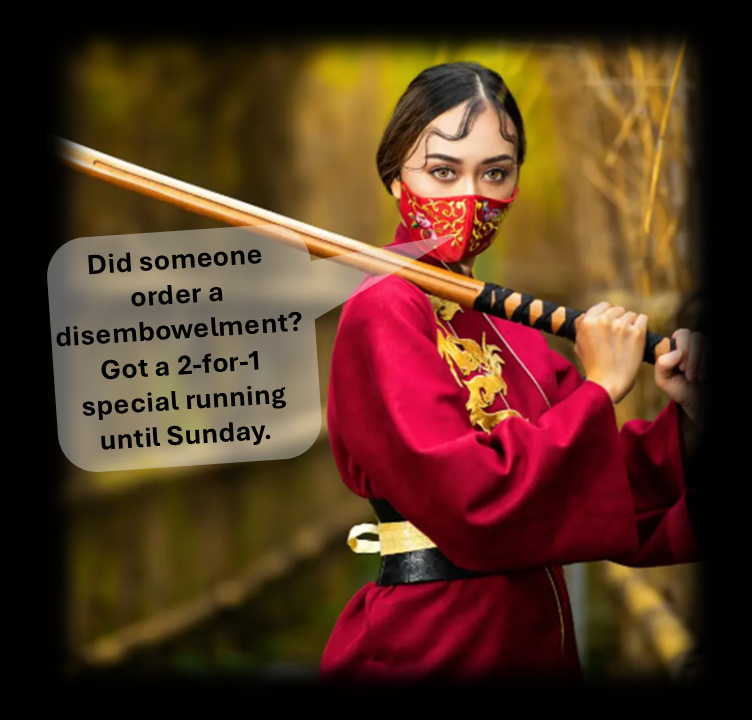
There was a small shack where the proprietor, who spoke English, was proudly demonstrating (and selling) swords. One of particular interest to potential buyers was called, and this is a guess, a kaisha kunin. Or words to that effect. The blade was, and another guess, four feet long, extremely strong, and razor sharp. It wasn’t something you keep in the knife drawer of your kitchen.
“So, is this generally used for mass bread slicing?” I asked that.
Well, no, said the proprietor. Its primary function was, but hardly limited to, beheadings. Of people. Beheadings of people. They were convenient for disembowelment, too, if that was of exceptional fascination.
Well, that startled me. “Get many calls for these things?”
Yes. Yes, he did.
I shrugged. “Seems a little harsh. I guess parents of teenagers might have use for a couple. For threatening purposes only, of course. It would act as a disincentive. I’d think twice if I were sixteen before stealing the family car for a joyride. Or is it a tool for capital punishment if the electric chair is out for repairs?”
Well, no. He said it was for ornamental purposes only. However, as a father of two teenagers, he saw its practicality in the arsenal of parental disciplinary options. However, I would do well to know that Japan is more humane when it comes to executing criminals.
You rarely hear “humane” and “executing” in the same sentence. It was a first for me, at least.
The gentleman said that, in the States, the court specified the date of execution months ahead of time, which caused unnecessary stress for the convicted criminal. In Japan, he said the prisoner got a two-hour notice that his ticket was about to be punched, which seemed, to him, much more thoughtful and considerate of the guy’s mental health.
Also, the executions themselves were much kinder and tidier because, after tying a noose around the criminal’s neck, they dropped the poor, dumb bastard about sixty feet straight down. It’s quicker and more to the point.
Regardless, the proprietor said demand for swords whose specified use was for beheading and disemboweling remained remarkably consistent and dependable during troubled economic times. So, yes, he made quite a name for himself over the years in the beheading and disemboweling game. It’s what he was known for.
Speaking of interesting niches, yesterday I saw a woman on Insta-Twit who, I guess, tests new products and gives first-hand reports as to their quality and effectiveness.
Recently, she announced her intent on personally trialing a caffeine suppository. You read that correctly. To provide a vital service for her viewers, she would insert a small tube of caffeine into a place where the sun, as a rule, does not shine.
It would appear there is a sizable, pent-up public interest in sticking objects up one’s ass. An untapped market, so to speak. Her earlier posts were averaging 400 likes. Her suppository post received 16,000 likes. Her subscriber count increased by 3,000%.
Now, this must have landed her at a creative and professional crossroads. Should she stay true to her core audience and continue testing critical new products for her loyal supporters? Or is it time to expand into a much more lucrative field which, in her case, happens to be in her ass?
Would she prefer to go down in Internet history as a woman who provided an essential service to consumers, or would she rather get rich and be known as the girl who shoved various things up her ass and told you all about it the next day?
I don’t know if she decided to eke out a living while staying true to her original vision or followed the money, which was, again, in her ass.
The sword guy went where the cash was: beheading and disemboweling.
On a side note, how bad does your coffee at home have to be before you resort to this as your Plan B?
The butt lady posted her review of her caffeine suppository experience a few days later. The caffeine experiment was a roaring success. Oh, it worked with a vengeance. To the degree that the poor girl looked like she hadn’t slept in weeks, had recently given birth to sextuplets without an epidural, and spent the previous twenty-four hours violently crying.
It was one of the funniest clips I’ve ever seen.
Back to Japan…
The only hostile or, at least, unwelcoming receptions I received were on the college campuses in the city. Students gave me an occasional sneer. A few walked away when they saw me coming. I watched a little of an amateur baseball game next to a university and was amused at the wide birth the college-aged kids gave me. I stumbled into a museum that was on campus and looked at rooms full of rocks and dead butterflies tastefully presented in large, clear boxes. I felt I was supposed to buy something, but I didn’t. As I left the museum, a student told me something in Japanese. I gave my standard response, which was, “Sumimasen. Nihongo ga wakarimasen.” (“I’m sorry. I don’t speak Japanese.”)
He mumbled something to the woman next to him. She listened, turned to me, and, with her eyes fixed on my shoes, said, “My friend want you accounting of America attack on Vietnam. Please. Thank you.”
It took a while to think of a response. I briefly bowed to both and said, “Well, hmmm, yes, right, right, thank your friend for his request. I’m afraid it’s not a short answer.”
Pause. I waited for her to translate to the guy who wasn’t displaying a good attitude. I continued. “I wasn’t there, and I can’t account for it because the American government never gave the American citizens an accounting. We received almost no information on what we did or why we did it. There’s more.”
I understand that I wasn’t being a fine ambassador for my country.
Pause. More translating. More mean looks. “Second, there is the American government and the American people. One has nothing to do with the other. Most Americans opposed the US involvement in Vietnam. The government felt otherwise. I’m not in a position to defend our government. There’s more.”
I waited for them to finish their back-and-forth. The woman said, “Yes. But he wonder you don’t defend your government. He feel every citizen has obligation to defense own country.”
I shook my head. “I’m glad to defend the American people. I will not defend the American government. There is no connection between the people and the government. America’s government does not represent its citizens. It hasn’t represented us for a long time. Perhaps it’s different in Japan. There’s more.”
They spoke for a while. She turned to me. “I think my friend remain angry at American. I tell him what you say. But citizen should account what done in their country name. He say still mad at America people for many atrocities.”
“Again, most of us didn’t support the American government’s atrocities. The American government does not represent its citizens. This is an important point. That’s why I’m repeating it. Besides, can you or your friend account for the Japanese government’s war crimes committed against China, Korea, and Russia? To say nothing of the horrendous treatment of prisoners of war held in Japan. I’m not angry at him or you about any of it. Should I be?”
Her response was immediate. “Japan people account for ancestors. It should be same in America.”
“Okay. We’ll disagree on that. I’m not going to be mad at you two. In America, we call this freedom of expression. I can’t control what was done in my name. Can you? That’s all. Nothing more to say.”
They had another dialog. A long one. She looked a little defeated. “He is say not on you but he very mad with government people.”
“Welcome to the club. It takes governments to destroy life. The rest of us try to keep the world from falling apart. Sayonara.”
I bowed. They bowed. We went our separate ways. Based on their facial expressions, the other students on campus were offended that I inhaled air reserved for them.
Years later, I re-encountered this sort of hostility when I helped a friend move his teenaged child, Reggie, into college. Reggie had adopted me as an honorary uncle when he was ten, and I was, and am, supremely touched by the designation.
The college was Hampton University. The students and faculty were all Black. As I helped move his possessions into the first-year dorm, I was greeted with stares of sheer disgust from the other students and their parents. I could hear their angry whispers behind my back. None of this surprised me, but I was concerned that my presence would cause Reg future grief from the other residents.
I was worried enough to ask him. “Is my being here going to destroy your social standing on campus?”
He laughed. “As long as they see you carrying boxes for me, I’ll be good.”
“Yeah, shut up.”
“Hey, I love you. It’s everyone else here who hates you.”
“Thank you so much. I feel four percent better.”
Back to Japan…again…
The more I discovered about Japan, the less enamored I became. Not with the people, either individually or in small groups. Other than the college students, folks were kind, humble, and respectful to a fault. Their allure faded as the groups got larger. In those settings, I felt their unrelenting arrogance that wasn’t entirely hidden behind the thick coat of subservience.
It wouldn’t have surprised me if Japanese folks felt the same when surrounded by a large group of Americans.
It still wouldn’t.
Japan’s treatment of foreigners left a lot to be desired. Other cultures were, and I’m being mild here, unwanted.
Then there was the “Burakumin problem.” “Burakumin” folks acted, looked, and sounded Japanese. Unfortunately, they had the bad taste of living in certain unapproved villages and received the designation of “extreme filth.” This uplifting designation provides insight into their treatment. From the sounds of it, they couldn’t get jobs, go to school, start a business, marry outside the village, or enjoy anything that approximated a decent life. The government urinated on them. Police urinated on them. The media urinated on them. Non-villagers urinated on them.
Laws were continually but, no doubt, reluctantly passed since the mid-1800s to offer minimal protections, but none were enforced, and all were ignored. In the late 1970s, a non-discrimination covenant found its way into the Japanese constitution. The result looked similar to the 1964 Civil Rights Act in the States in that no one in the majority gave a rat’s ass.
Maybe the lack of political correctness threw me for a loop. It was a subject of rare candor from the majority in Japan and ran along the lines of “kill them all.” At least in the US, we white people pretend to care, although, in 2024, that’s starting to fade.
During my first visit to Japan, the whole damn place struck me as a massive pile of restrictions and unreasonable expectations on the citizens. The elementary schools taught their students how not to think. Instead, they were instructed to stay within the lines. People didn’t learn in the school system. They succumbed to it. Anyone casually observing could see the crushing isolation. All alone in a very dense crowd.
Were they oppressed? Repressed? Depressed? Lonely? Stressed? Exhausted? Anxious? Disconnected?
Yes.
Yes, they were.
As for Emi, we returned to New York. We stayed friends.
She moved to Los Angeles and found remarkable success in her scientific world.
She left her family in the dust and was much happier as a result.
In 1987, she died shortly after being diagnosed with a late stage of pancreatic cancer. In our last conversation, we fondly remembered our visit to Japan. We felt privileged to have spent the time together.
The men in her life did everything possible to cause her irreparable harm. They hurt her badly. But her damage, to a great degree, was undone. She had no reason to trust me, but she did. It meant a lot to me.
It still does.
I will remember Emi as the butterfly who emerged from her difficult cocoon over a few days, found her wings, and flew for a joyful few years.
It was a rare honor to have had a front-row seat to witness this.
—THE END—




 BOOMER(S) GONE WILD!
Leave a comment