

It was May. The semester was over. The campus was empty. My roommate was gone for the summer. The apartment was fortified with ten cases of beer, frozen pizzas, Ramen noodles, potato chips, a thirteen-inch black and white TV, a record player, a bed, a sofa, a table, a chair, and a telephone. I stayed locked in the apartment on the grounds that it was safe because I had blocked the door with the sofa, the table, and the refrigerator.
I was aware of my emotionally deteriorated condition. I sequestered myself because the world was better off with me locked up.
When it comes to psychosis, I am a monument to social responsibility. Aren’t I?
Much of the time was spent running to the bathroom because I drank exactly sixteen cans of beer each day using the logic that averaging one beer every ninety minutes amounted to evidence of my reasonable alcoholic restraint.
I am so in control.
I spent hours staring at the phone, wondering if it would ever ring. For the first six days, it didn’t.
The TV always stayed on. I wasn’t familiar with the television shows. After a week’s worth of TV viewing, I was sorry I found out. In an exceptional moment of clarity, I determined my country’s unrelenting infantilism resulted from those television programs.
The most popular show in the US was “Three’s Company.” It centered on two women and a man who shared an apartment and played slap-and-tickle with each other.
Another prominent show was “Charlie’s Angels,” where three women played slap-and-tickle with each other and with stupid men.
For good, wholesome family entertainment, you could watch “Little House on the Prairie.” Almost twenty-five percent of the country’s viewing public watched it. It was a heartwarming portrayal of a family of simpletons overcoming challenges by boring the hell out of everyone, especially the viewers.
“Electric Ladyland” by Jimi Hendrix was the only record I played the entire week. Over two hundred records were in the room. Finding a different one required a level of ambition well beyond my capabilities.
If you expect to have a Force-Twelve meltdown, hide the “Electric Ladyland” record. It will delay or negate your return to reality. Spooky sounds throughout will turn your paranoia into something that stands up and talks. (The natural question is, “Why did you keep playing it?” Your guess is as good as mine.) If you have, as I did, valid concerns about the furniture moving on its own, then see if you can throw on a non-threatening children’s record. It will be your best hope. Try one of those traditional ones. Perhaps “101 Dalmatians Go To Amsterdam and Get Seriously Laid.” Maybe “Disney Princess: The Return of the Cunnilingus Fairy” (the companion storybook is a must).
Just avoid Jimi Hendrix.
Having these sorts of weird spells wasn’t unusual. Sometimes, they ran for a few weeks; other times, for a few months. I remember seeing, at age seven, cartoon characters on the living room wall. We’d have extended conversations. This went on for a month. I’m told I hallucinated before I was seven. It was part of my life.
After a week, I made the practical decision to drink more beer, which, as far as this current fling with insanity was concerned, did the trick. The following day was when the fog lifted, albeit with an appalling hangover. I felt strong enough to put the furniture back in place and clean up the mess. I stepped outside and went to the local drugstore as I ran out of soap on Day Two.
Just as I stepped back into the apartment, the phone rang. The caller was someone from a previous semester’s class. I knew him through my roommate. His name was Mark. He was calling from Asheville, North Carolina. Since calling from Asheville, North Carolina, to Washington, DC, was a long-distance call in 1977, the conversation had to be quick because long-distance callers would be billed a painful amount of money for each minute. In those days, no one had the slightest idea of the actual per-minute cost.
All we understood was the phone company (no one knew if it had an actual name) had a unique price structure as the phone company (there was only one) charged whatever the hell they wanted, whenever the phone company wanted, and had no intention of telling anyone what the correct cost of your long distance call would be but the good news for consumers was the phone company had, for your convenience, great discounts if you made a “station-to-station” call, for instance, then you were in luck since the first three minutes of the call was 50% off some random number just as long as the call ran under three minutes as there was a service charge for the fourth through seventh minute of 225% of some undisclosed dollar amount but the better news was “person-to-person” calls decreased by 133% which we, in 1977, didn’t realize was mathematically impossible but additional discounts may be available if you called from a specific part of the country to another location as, in this case, rates, for your convenience, could be deeply discounted (amount unknown) for the first four minutes and thirty seconds before being deeply increased (amount unknown) to say nothing of the amazing bargains available for calls placed between 7pm and 7:23pm and the weekend rates received 85% off the usual weekend rates which hovered near $40 per minute (total guess) for the first minute so think of the savings although if you needed an operator to assist (which was most of the time) then all bets were off and you should be prepared to cough up quite a bit unless it was during 1am to 4am when rates for operator assisted calls included a discount of 25% from a standard rate which was, for your convenience, to be determined much later but none of it mattered as the billing system vendor, who was hand selected based on kickbacks, wasn’t very good so you didn’t have any clue what the bill might be and you’d be billed $34,883.02 even though you made NO long distance calls, but there was no one to call at the phone company because the phone company never answered the phone so you had to shut up and pay in full or your phone service, including local calls and 911, would be cut off for your convenience.
Out of economic necessity, my conversation with Mark went like this:
MARK – Yeah, want a job for a month?
ME – Doing what?
MARK – Junior camp counselor. I’m a counselor. I need a sidekick. You don’t do anything. Just sit around and count the number of kids. We need one or else we can’t open camp on time.
ME – How much?
MARK – $230 a week plus food.
ME – Where? Sorry.
MARK – Yeah, Camp Ridgeview. Near Asheville. North Carolina. It’s on the map. When you get to Bristol, head south; it starts on Monday.
ME – Sure.
MARK – Pack some camping clothes. Call me when you’re close.
[click]
Business decisions had to be made quickly over the phone in the 1970s.
My car wasn’t a car—it was a motorcycle. Someone gave me a used, rebuilt Honda 750 because he wanted it out of his life. It was a dependable ride, assuming it would start.
I shoved what I could in a duffel bag, carried it like a knapsack, jumped on the bike, spent three hours trying to start it before it finally turned on, and got to Asheville as fast as possible.
America today is very different from the one in 1977. Nowadays, if there are more than fifty people within one square mile, you’re bound to come across a Walmart, or K-Mart, or Sam’s-Mart, or somebody’s Mart. It doesn’t matter whose. They all sell the same crap.
Inside a one-hundred-foot radius of any Mart, you’ll find fast-food restaurants: Fatburger, Lard in the Box, Dunkin’ Dough Burgers, Taco Burger, Five Guys In-&-Out Wendy’s Frosty Burger, or whatever. It doesn’t matter. They all serve the same crap.
Next an enormous shopping center that contains Amazon, Hot Topic, Stupid Topic, Forever 2, Bad Breath and Beyond, Dollar Store, General Dollar, TJ Discount, Old Navy, Family Dollar Store, etc. All these places have Outlet Stores, Factory Stores, and Bargain Supercenters at the same shopping center. They all sell the same crap. All at the same price. All the time. For ambiance, a nearby food court emits an odor similar to the Sewage Treatment Bargain Factory Outlet Facility in Juarez, Mexico.
In 2024, every city, town, village, hamlet, municipality, borough, or commune in my country has transformed into a cheap, tacky shopping plaza including fast-food-lard restaurants, somebody’s Mart, seven stores implying they have crap you can buy for a dollar but don’t, a food court possessing a smell that defies any description, a drive-through beer and wine factory-outlet-bargain-supercenter selling “premier beer in baggies,” and a row of terminally out-of-order soft drink machines. Also, there’s an ATM without money in it. Plus, you’ll find a convenience store where you can urinate all your money away on lottery tickets for your convenience.
To make the country a relentlessly duller shade of taupe, we all watch the same semi-porn on Netflix (“Some Half-Wit Does The Volleyball Team” is a top-rated reality series), the same cute YouTube videos (“Left Wing Extremist Cats Eat Asbestos and Vomit on a Meme of Netanyahu”), and stare at the same social media posts written by the same two-year-olds displaying the same astounding ignorance of the same subject matter they’ve been posting on since day one.
This is America as we speak: a corporate junkyard. It’s all the same. Everywhere. We Americans are all the same. Everywhere. Big cities? Small cities? No cities? All the same. No difference.
In 1977, you could go two hundred miles in any direction and feel like you had dropped in from Mars. As the crow flies, Asheville is four hundred fifty miles from Washington, DC. Four hundred of those miles were in rural territory.
There was no Internet. The citizens of Arizona had yet to learn what people in New York got up to. And vice versa. Commercial television provided vague information during a daily thirty-minute newscast.
Folks in more remote areas of the country didn’t have televisions, and if they did, getting access to a watchable TV station was hit-or-miss.
Outside of the big cities, the only readily available newspapers reported local news. Besides, folks in rural areas were busy working fourteen hours a day and too tired to give a rat’s ass about what Trinidad and Tobago were up to, who happened to be president of Uruguay (answer: nobody), or how “Save Your Kisses for Me” won the Eurovision Song Contest.
In more remote areas, which, geographically speaking, amounted to 75% of the country, you had nothing. No TVs, no radios, and no newspapers. The likelihood of receiving a letter within twelve months of the date it was sent was five percent.
Rural Americans had telephones. No one could use them as there was only one phone line for ten different households. The telephone line was tied up by some fourteen-year-old and his girlfriend. In those days, they were referred to as party lines. When I was six, I learned much listening to those party line calls.
If, in 1977, you lived in, let’s say, Daniels County, Montana, where the population density was one square mile per person, then your interactions outside of Daniels County were mighty limited. You received your news fifteenth hand at a general store or in a bar from someone who was, most likely, drunk or stupid. Or both.
The point is there was no reliable (and sober) news service. The quality of information received in Daniels County was of the same quality as a gram of cocaine after it had been stepped on fifteen times.
For instance, in 1977, the Son of Sam (mass murderer David Berkowitz) got arrested, Elvis Presley died, and Jimmy Carter was sworn in as president.
By the time it reached most of rural America, the news was the son of Sam Carter got arrested for the murder of Elvis Presley and for swearing at the president.
Regardless of location (urban or rural), folks maintained an elevated level of suspicion of any outsider. Most folks were armed, so you had to behave. The level of suspicion was high. In the Internet age, we verified what we suspected in 1977: everyone hates everyone else.
Asheville is in the Appalachian Mountains. As you’d expect, cultures, languages, behaviors, interactions, beliefs, and social norms in Asheville differed significantly from those in DC.
And food. The difference in dietary habits was comical. In Western North Carolina, the cuisine options included barbecued pork, and Cheerwine Ice cream floats. And nothing else. Both are preposterously good and profoundly addictive. Healthful? No. Deadly? Absolutely.
I stopped at a small convenience store for, among other things, a soft drink.
The cashier, a disturbingly friendly girl, pointed to her right and said, “Dope’s ‘round the corner.”
Uh, fine. Great. You sell dope here. Did you make some assumptions at first glance? Cheeky, presumptuous, little fourteen-year-old.
There was no pot ‘round the corner. There were bottles of Coca-Cola, which is (or was) called dope in the Southern Appalachians.
I meandered through the store for other essentials. I picked up a carton of cigarettes. In those days, tobacco products weren’t all hidden behind the cash register. You’ll be thrilled to know a carton of Marlboros ran a whopping $3.50. Thirty-five cents a pack. Retail. I don’t know what a pack of decent cigarettes goes for now, but I suspect it isn’t thirty-five cents.
The frighteningly friendly girl said, “Ridin’ a motorcycle pretty crazy, all the ball-hootin’ going on.”
Initially, I smiled in agreement before giving her a quizzical look. She smiled back and said, “Folks drive pretty wild.”
How very reassuring. I was doing fine until you said that.
She followed up with, “Jasper, huh? Up north?”
I took her questions to mean where the hell was I coming from. “Yeah, Washington, DC. Sorry. I go to school there.”
She replied, “Got family there. Everybody is so mean. Angry. Folks don’t smile ‘tall.”
“Well, I’m friendly. We may find another friendly one in a couple of years.”
After paying for my selected items, she said, “Y’uns want a poke?”
Wow. You are friendly, all right. If it weren’t for the fact that you’re exceptionally not an adult and I have to be somewhere, I’d be happy to oblige.
She handed me a poke, which closely resembled a paper bag.
“Sorry. Thank you.”
She continued with her creepy smile and said, “Put it in your tow-sack.”
In my toe-sack? You are a bit unschooled when it comes to anatomy. Usually, a toe isn’t where you find these things.
Amused at my bewilderment, she pointed to my duffel bag. I left. She stared at me until I took off.
The locals I met or passed while driving were affable. Folks waved. When I stopped, those nearby said hi. Despite the pronounced difference between us, I couldn’t help but feel welcome even if I wasn’t.
It was not all cookies and cream, of course. Poverty, bigotry, local corruption, police brutality, lawlessness, environmental destruction, and domestic abuse were rampant. We think these things are at an unprecedented level today. They’re not. It’s not close. We just have videos of them now.
The small towns in the valleys (aka, “hollers” if you’re keeping track) were in the early stages of decay. The larger coal mining companies left. Tobacco farmers started to feel the drop in demand. Neither industry would be coming back. As far as employment alternatives, none existed.
Since the mid-1980s, Asheville has been and continues to be a great city. It’s fun, slightly artsy, and, as cities go, down to earth.
In 1977, it was a small town and appeared to be heading in the wrong direction.
Between 1960 and 1980, Asheville’s population dropped considerably. The locals acted friendly, but little else recommended the place. Main Street was run down and beaten up. Double-digit inflation will do that to your Main Street. The large office buildings (comparatively speaking) had very few people in them. Most of the city looked gray.
I found a pay phone (not an easy task) and called Mark for directions to Camp Whatever. The camp was less than 25 miles from Asheville, but it was still a long-distance call, so I had to keep inserting coins before the call disconnected. As experiences go, phone communication was an expensive dumpster fire and the reason the post office did so well.
When my motorcycle and I arrived at camp, four older adults greeted me with hostile stares. (At the time, I defined older adults as over forty.)
The gang of four had their arms folded and “get the hell outta here” facial expressions. None of them spoke, so I broke the ice. I kept my handy persona in place.
“Howdy. Looking for Mark. Any idea where I can track him down?”
After a pause, the youngest one sneered, “Who are you?”
“Yes. Sorry. Drew. Mark said he needed an extra counselor, so…”
“Junior counselor.”
I paused out of annoyance while maintaining my aloof, upper-class, Oxford-educated persona. “Ah, yes. An important distinction. I guess. Mark said he needed a junior counselor for a month. Any chance Mark’s…”
“He give you the full job description in its entirety?”
Excellent redundancy, A-Hole.
“No. Neither in full nor in its entirety.”
“Mark tell you how to check in here in person?”
Ah. Not only do we check in at Camp Whatever, but we do it in person.
“No.”
“Mark say we need your application completed in full?”
Are all sentences redundant around here?
“No. Sorry. He did not. I have no application that’s either complete or in full.”
“Well, what the hell did he say when he spoke to you?!”
What did he say when he spoke? Are you kidding?
“Mark said he needed a junior counselor for a month.” After a long deadpan pause, “It was the sum total complete 100% in full information he gave.”
“You qualified for employment for the junior counselor job?”
This is unbelievable.
“I have no idea either for employment or the job. Sorry. I don’t know the lofty qualifications and chances are I will not meet them. Look, this has been a glorious conversation but I must be in the wrong place. So, I’m going to take off…”
You eighteen?”
“Nineteen, if I’ve done the math correctly. I’ll see you down the road…”
The youngster of the four had turned away and yelled, “Hey, Mark!”
“I could have done that.”
The gang of four had already returned to their conversation.
Mark arrived. “Hey. Come on up.”
Another of the gang turned to me and said, “Best you get your motorbike outta view.”
“And where would that be?”
Mark jumped in. “Just put it in that shed, and we’ll get you to the cabin.”
So, I did and then returned to the demilitarized zone of the camp. As Mark and I started walking, the annoying youngster spouted, “You bring your Bible?”
This was not a question I expected.
My response was flat. “No. Sorry.”
“Do you even have a Bible?”
“No.”
“Truthfully, have you ever actually read the Bible?”
“Yes. Actually, and truthfully.”
“Oh, really? What’s your favorite passage?”
“‘Stand firm with the belt of truth around your waist and breastplate of righteousness, and the readiness from the gospel. Take up the shield of faith and extinguish all evil arrows.’ It’s not word for word, but you get the idea. It’s from Ephesians. Sorry.” We stared at each other for a few seconds before he returned to the gang.
We walked up a hill.
I turned to Mark. “This guy needs a girlfriend yesterday. Two, perhaps.”
Mark was slightly embarrassed. “Yeah. Yeah, I know. Believe it or not, he has a girlfriend.”
“I need to speak with her immediately. She is not getting it done.”
“Yeah, they’re waiting until they’re married. In December sometime.”
“There is no way in hell he will make it until December. He may not get to tomorrow. Can she throw him a little something to tide him over? Otherwise, the wedding night will be a catastrophe, and they’ll need to be rushed to the hospital. Ain’t gonna be good.”
“Yeah, no. They wait. It’s kinda how they do things here. How’d you do in Matrix Theory?”
That was the class we attended.
“B. Minus. Only after I showed the professor compromising pictures. It wasn’t easy. I had to chase him for three days with my camera. You? A, I’m guessing.”
“Um, well, yeah. I knew a lot of the stuff already. So…” He wasn’t one to brag. He continued, “Yeah, thanks for doing this.”
“You sounded desperate. And I needed to get out of town for a few weeks.”
The cabin contained seven bunk beds and two single ones. Thankfully, I got a single. We didn’t know each other very well and didn’t speak much during my stay. Mark was certainly nice enough but awkward and way too shy to be a camp counselor. Eye contact was not something he managed well. These days, he’d have qualified as someone on the spectrum.
After settling in, Mark asked, “Do you know the Bible? That was a good passage.”
“No. Sorry. I don’t. I just remembered it from somewhere. It sounds cool. I did church in elementary school but stopped.”
“Oh. Yeah, okay.”
“Is Biblical knowledge part of the puzzle?”
“Yeah, yeah. We talk about it a lot.”
Thanks for letting me know.
“If you have a spare Bible, I can peruse it.”
“Yeah. Here’s one of mine. Hey, thanks again. I appreciate it.” That’s nearly all he said to me for the entire month.
The Bible he gave me was beat up. Key passages had been highlighted, so I read them. I figured context might have mattered, but I didn’t have the time or inclination to find out. I looked through what he had marked in the Old Testament.
It was the first time I had ever read any of this.
My first thought was that the Israelites didn’t seem quick on the uptake because a recurring theme went unnoticed by everyone involved.
First, God gave people all this great stuff and blessed them up one side and down the other. But God was clear on one point: there were rules. Simple rules. If one-and-all played by them, it’d be all good. Things would be fantastic. Just stay within the lines. Easy. Nothing complicated.
God then told everybody that if individuals chose not to play by the rules, there would be a “little problem.”
He then explained, in brutal detail, what the “little problem” looked like if the general population went off the reservation. It involved a ton of frogs, lice, flies, livestock pestilence, boils, hail, and locusts. The world would always be dark, and the water would taste suspiciously like blood because it was blood. Plus, everyone might need to keep those life insurance premiums up to date as their families will be submitting the claims in short order.
I did not think God was hedging any bets or being negotiable. There was no mention of a plea deal for a first offense. When it came to leverage, the Israelites had none. Not a drop. God painted an “I’m telling you the way it is” picture. Simple. Play by the house rules = good. Don’t play by the house rules = “little problem.”
It was the most straightforward line of code: If X, then Y.
As I thumbed through the Old Testament, the recurring theme was that folks played by the rules, and all was hunky-dory until, in one swell-foop, everyone decided, “Screw it. Let’s have a debauch, grab some false gods, and do whatever we’re not supposed to do.” Okay, fine. They were informed of what would happen. It should not have been a mystery.
Inevitably, the Israelites became plagued with whatever plagues were available then. Everything sucked, and no one could figure out what the issue was. Crowds panicked, ran in circles, and bellowed, “Hum-in-uh, hum-in-uh, what’s going on, what’s going on?”
This would continue for years until someone ran to God, whining about the current situation. “Lord, thou hath sucker-punched thy chosen ones, and have deposited flying frogs or whatever-eth these things are, and thine people are unable to find the Holy Land on accounta if we’re not dead then we are knee deep-eth in these frog-eths or whatever, and it’s thou’s fault.”
God’s response, and I’m paraphrasing here, was, “Yes, and…? You knew this was coming.”
Had I been in God’s position, I might have said, “Look, dipshit. I told you, morons. It’s in the code. If X, then Y. Play by the house rules, then good. Don’t play by the house rules; then, there’s a little problem. Welcome to ‘little problem.’ Now, shove off. I gotta find more frogs.”
After another few decades, the Israelites would say to God, “Look. Sorry. We kinda got pulled in different directions. I mean, we’ve been busy. Lots going on. So, look. Um, if we behave ourselves, how about cooling it with frogs or whatever these things are?”
God, showing a stunning amount of patience, replied (paraphrasing), “Fine. If you play by the rules, I’ll pull the plug on the frogs or whatever these things are. But look. These plagues get a lot worse, so stay on the program.”
“Oh, yes, Lord. Thank you, thank you, thank you. Thou are merciful, and you’ve been totally understanding during the whole thing; we learned our lesson, we’ll never forget to play by thou’s rules, and we won’t ever go outside the lines again because we’ve discovered a lot about ourselves over the last few decades. It all makes sense now, so you can count on us. This time, for sure. Trust us.”
Everything was good again, but after a few years, people forgot the rules, everything went to pieces, and no one understood why.
Rinse and repeat.
Concerning the New Testament, it seemed that Jesus was surrounded by individuals who, cerebrally speaking, couldn’t get out of the parking lot. All the information went in one ear and out the other. Jesus offered enlightenment and performed all these fantastic deeds. All he got in return was, “Um, can you, like, show us another miracle or something? Yeah, do the wine thing again!”
After a few days, I’d have found a jar of water, turned it into bourbon, and gotten drunk for a long time.
I finished my nickel Bible tour in time to meet the ten-year-old boys living in the cabin. We greeted the pampered, elitist, whiny, entitled, rich, arrogant, unpleasant, extremely white children for whom the rest of us existed to take their orders. Those were the parents. They devoted their time to either pissing and moaning concerning something irrelevant or throwing their weight around to win some ridiculous concession from the camp.
The kids seemed okay.
Mark was weird and obsessively shy. He barely spoke to anyone. I’m not sure who thought he’d make a good camp counselor for ten-year-olds. The camp must have been in dire need.
The job of a junior counselor was to count the number of children you had in the morning and confirm you had the same number of children at the end of the day. The days began with all the age groups of children sitting at the lake. One of the gang of four would drone on for a long time about being a genuine Christian, which, in this case, meant badmouthing anyone who wasn’t and then leading a prayer asking God to send non-believers to Hell, during which most of the kids tried not to fall asleep. After breakfast, the children were dragged from one activity to another.
Mark abdicated all leadership duties and passed them on to me.
Before lunch, the children sat through a Bible study led by the counselor. The idea was to take some passages and run them by the kids in a relatable way. Listening to them was painful. Mark was comically bad at them. “Yeah, uh, guys. Faith is, yeah, like a tree. Yeah. You must water it a lot. The roots must, yeah, get rooted. And, faith, and roots, yeah, of faith…” The kids mostly stared into the distance.
The children endured more activities in the afternoon before we assembled for dinner. However, no one was allowed to eat until one of the gang members gave a sermon reminding the youngsters they’d be going to Hell unless they, the youngsters, spread the Word by telling everyone else, “Yer goin’ tuh HELL!”
After dinner, the kids played for a while before returning to their cabins, where they’d play for the rest of the night.
The ten-year-olds and I got along well. I spent most of my time teaching or playing basketball, baseball, and football with them. Occasionally, one of the kids had a meltdown. I would take them out for a walk until the storm passed which was all I knew to do. I’m pretty sure they had a good time. I did. I felt a million miles from the person I left in DC.
The only hoo-hah I caused was when Mark twisted an ankle and asked me to conduct a mid-day Bible study at the last minute. This was a problem since I hadn’t touched a Bible since skimming through it the day I arrived. Now, I had to take a verse and talk about watering some trees. I didn’t know any Bible verses besides the one I spewed on my first day.
I had to pull something out of my ass quickly. Thinking of an exercise a football coach once put us through, I found a pole and planted it in a field one hundred feet from where the kids sat. I told two of the kids to walk to the pole. But, they had to walk backward and not look at the pole. Both walked backward and missed the pole by thirty feet. I told another kid to walk to the pole, but he could only look down. He badly missed the target.
I gathered them together and said, “What’s the moral of the story?”
It took a few minutes before someone said, “Uh, don’t look backward, and don’t look down.”
The kids laughed.
I said, “You are right, Sir! Jolly good.” They liked “jolly good. “So, who wants to find God?” They all dutifully raised their hands, although only two were being honest. “I don’t think you’ll find God if you focus on the past. The past is behind you. You won’t find anything if you only focus on where you are. Don’t look back. Don’t look down—God’s in front of you. You’ll find Him quicker if you stop dwelling on the past and worrying about where you are at the moment.”
I thought it went well, considering I had no notice.
The gang of four did not agree, as this wasn’t the time to walk around. One of the gang wanted to know what I had to say for myself.
“Nothing.”
After a pause, the gang wanted to ensure I knew never to conduct a Bible verse review.
“Thank God. Sorry.”
No one saw the humor in my extraordinary display of irony.
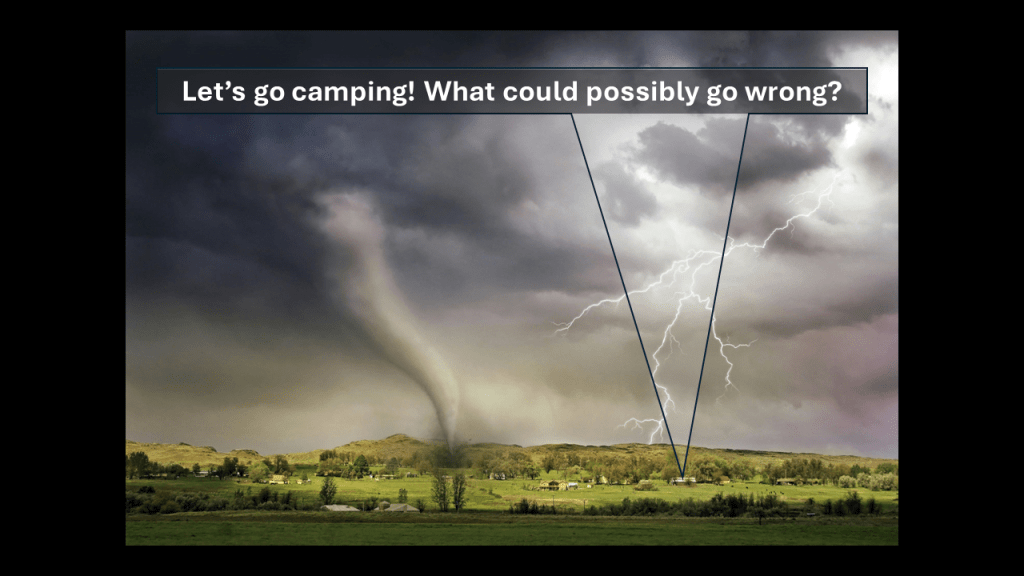
We went camping a lot. I discovered a new level of hatred for camping.
Then, we led the little ones on a hike to the top of Mount Mitchell. Mount Mitchell goes up a lot. It’s the highest mountain east of the Mississippi River, so it takes all day to walk up the mountain. The whole thing seemed pointless to everyone who had to walk up the mountain. It rained most of the walk, but that was nothing compared to the hurricane we enjoyed once we reached the top of the mountain. We couldn’t do anything other than stand, get slammed with sideways rain, and eat soggy marshmallows. It stopped raining after midnight. I could account for all the youngsters. By 2 am, we got everyone set up with tents, started a few fires, and ate something of unknown origin. One of the gang wanted to gather close and have an extended prayer, thanking God for the beautiful time we were having and reminding God there were a whole bunch of sinners He should kill. The campers and counselors said, in unison, “No.” Immediately after, everyone fell asleep in the mud because no one cared anymore.
Due to the joy and contentment, I couldn’t sleep. I was still feeling soggy and disgusting. However, I was a man of priority. I had wrapped my cigarettes and lighter in abundant plastic before the hike, so they were nice and dry.
After a few hours, I stepped away and found an unobstructed view of the surrounding mountains. Clouds fell below the mountain tops, and the sun was starting to appear, creating a magnificent vision.
I didn’t have a point of reference regarding spiritual experiences. I hadn’t seen or been part of one. Psychotic episodes? I was good there, but I heard about all these beautiful moments of spiritual awakening when standing at the top of a vast mountain.
I read Siddhartha, which contained moments of spiritual insight that made the guy sit a lot. If I understood the book, then getting down, in a spiritual sense, required a few elements. Nirvana was one. It’s always nice to have plenty of Nirvana on hand. Moksha was essential, of course. Extra Moksha was necessary. Prajñā. You needed to pick up Prajñā ahead of time for the party. Vidya was a big one. Double shots of Vidya. Good stuff, Vidya. Dhyana, too. You had to learn how to do the Dhyana. If everything’s five by five, you are looking at big-time Samyak Sam Bodhi, which means you are the Spiritual Man.
As you can tell, the book flew over my head.
While I stood at Mount Mitchell’s top, nothing cosmic popped by, as best as I could tell. Looking at the tops of trees on other mountains was fine. Instead of considering the intricacies of the universe, I lit up a cigarette and enjoyed it, which isn’t a spiritual experience.
At least, I doubt it’s spiritual. Depends on what you’re smoking.
From a distance, the mountains looked very bright and inviting. Things darkened once trees surrounded you on one of the mountains. Plus, nature isn’t the most visually appealing site when it’s right in front of you. If you got lost, longevity was not on your side. Every native I met had two or more stories regarding those who went to the mountain, for hopelessly last, and never returned.
Looking back again at the mountains from the top of Mount Mitchell, I was overwhelmed with sudden insight. It was profound. I thought I’d been struck by lightning. I heard a simple message that shaped my life for years. As clear as a bell, I heard, “Everything looks fine at a distance. Once you get close, it all looks ugly, then you’ll get lost and die.”
By the third week, the camp had become boring. Every day, we herded children to the same activities. Twice a day, the gang of four bludgeoned us all with uplifting sermons in relation to non-believers needing to get with the program, or they’d burn a lot. Sinners, too.
The children received ample encouragement to get amongst the masses and let the non-believers know God hates them quite a bit. Non-believers were not welcome in their churches unless the non-believers started believing with all their hearts, but at no time did any of the gang explain how non-believers were supposed to believe in anything, especially if they’re not allowed to enter your church because a church is a place to worship God. Still, God hates you, so don’t come to our church until you love God, who, in case you forgot, hates you.
Sinners, too.
The gang also bitched about church attendance dropping in the US.
The last few days at camp became excruciating, consisting of long celebrations during which the gang of four reviewed all the beautiful things we had accomplished despite all evidence to the contrary. The vibe from the four was so negative that most of the kids would not look at them.
On the final day, the youngsters all departed before 10 am. We were paid in cash, which was nice. The gang announced an outdoor get-together that night and invited the counselors to stay. Fun, they declared, would be had by all. I considered sticking around. I returned to the cabin to shove my possessions into my duffle bag. Walking in, I couldn’t help but notice the KKK robe on Mark’s bed. I stopped dead in my tracks. I felt like I was on a plane that dropped two hundred feet while simultaneously getting the breath knocked out of me. I never found the Klan threatening because I met all their ethnic requirements, so the KKK never came after me. But fear crushed me. There was no practical reason to be afraid. It was just a robe, but the terror I experienced was mighty. It was fight or flight time. I could have fought the robe and might have won, but I desperately wanted to turn and run to the next country. Unable to look at the damn thing, I threw everything in my bag and got out of the cabin as fast as possible. I walked down from the cabin just as Mark walked up from his shower. Unable to look at the guy, I asked if the little get-together was a Klan rally. “Yeah, uh, yeah. Yeah, you’re going to come?” Still shaking, I walked away without responding. One of the gang of four asked, “You’re not coming to our party?” “No.” “Where are you going to?” “Anywhere but here.” My motorcycle started on the first try. It undoubtedly wanted to escape as much as I did.
I stopped for gasoline outside Asheville’s city limits, heard music nearby, and spotted six folks playing traditional Appalachian folk music on porch steps. The instruments included a banjo, dulcimer, acoustic guitar, fiddle, mandolin, and spoons. The musicians, outside the occasional smile among themselves, all stared into the half-distance. These six musicians wove the songs together beautifully.
Of course, they made it look easy. (I hate it when they do that. I pretend to play guitar. It’s not easy for me to play and not easy for anyone to hear. I’m told it’s because I’m no damn good at it.) The musicians didn’t break a sweat.
The two dancers on the porch sweated up a storm. Both gentlemen performed something resembling an Irish jig with a lot of tap dancing. Fifteen or so onlookers clapped along.
Some of the songs sounded like revisions of traditional Irish ballads. A few songs were about some guy trying to get his girlfriend to hop in bed (although in a subtle manner when broaching the subject).
Mostly, the songs revolved around workers being abused, the Great Depression, moonshining, and fighting someone else’s war.
The band and onlookers were interracial. This was 1977 in the Confederate South, where very little interracial activity occurred.
When they took a break, I ran over to the band like a twelve-year-old girl at a Taylor Swift concert to shower them with praise.
All six had been friends since childhood. Their parents didn’t care about anyone’s color, so they spent time together and played music together from day one.
All the other parents were concerned, the school system was concerned, law enforcement was highly concerned, and the town “leaders” had their undies in a knot over the whole thing.
As the guitar player told me, “The kids get along fine. It’s the adults.” To which anyone within earshot sighed as if to say, “Amen.”
That was Asheville. I headed back to my motorcycle. Just as I was leaving, one of the dancers mentioned an appropriate method to show my gratitude for the beautiful entertainment was to buy a Mason Jar of the band’s world-class moonshine.
I bought two because what could be a better idea than getting drunk as a skunk while riding on a motorcycle for hundreds of miles?
I made a lot of bad decisions in those days.
I should be dead.
I understand that.
—THE END—



 BOOMER(S) GONE WILD!
Leave a comment