
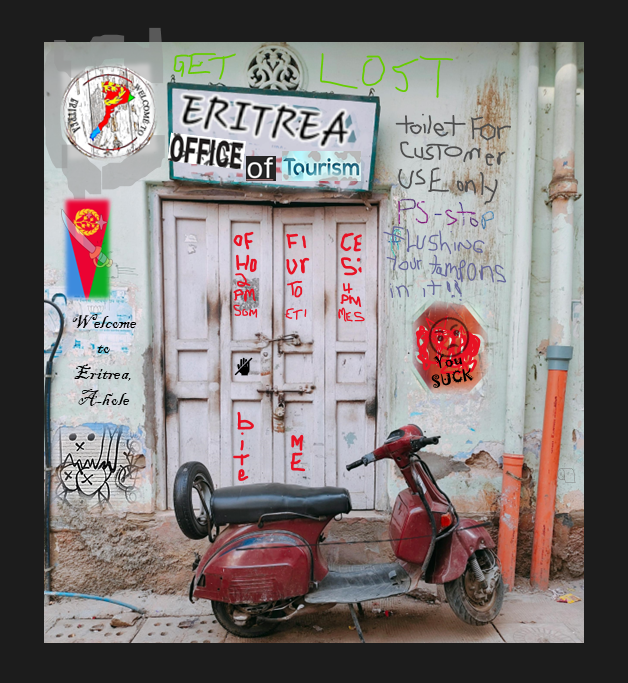
Question: What do we know about Eritrea?
Answer: Not much.
It’s a country in East Africa. The Sudan, Ethiopia, Djibouti, and six hundred miles of beautiful Red Sea coastline border it. You will find a few hundred islands under Eritrea’s domain just off that coastline. Between the lack of fresh water and some of the world’s most aggressive snakes (other than those in the ruling class), most islands aren’t places to take the family for a vacation.
There are plenty of these unsociable snakes on the mainland, too. Those things have genuine attitude problems and will, if given the opportunity, fuck you up.
Don’t play with the snakes.
Beyond that, things get fuzzy.
Due to the negligible flow of information from its government, Eritrea is sometimes called the North Korea of Africa.
We don’t know how many people live there. The UN thinks the number is around 3.5 million. The Eritrea Ministry of Information says it’s closer to 5.8 million. Other estimates from international agencies tell us it’s over 6.2 million.
The country’s per capita GDP (based on purchasing power parity) is anyone’s guess. In 2011, the World Bank thought it was around $1,600. The IMF never chimed in on the subject. The number is undoubtedly in the Somalia, Congo, and Mozambique range. This puts the country close to dead last in the world.
I’m sure it’s better than South Sudan. So, that’s something.
The country’s worldwide credit rating is shot, and no one will lend them enough money to buy a carton of cigarettes.
A third of the population may be Christian. Hard to tell. It could be half. The other half is Sunni Islam. Or more. Or less. No one knows. Christianity (specifically, Orthodox, Roman Catholic, and Evangelical) and Sunni Islam are the dominant religions. One reason is that they are the only religions registered with the country’s government. For any other religion to be recognized, one must have it registered. You’d think that’s easy enough to accomplish. Fill out the paperwork, submit it to the government, and get that bad boy on the books. The government will review your submission and, after their careful examination, reject it. Once your religion is denied, keep your worship to yourself. It is a matter of health, Happiness, and longevity. Primarily yours.
And your family’s.
Speaking of Eritrea’s government, totalitarianism reigns. Opposition from other political parties is outlawed. The state controls everything and everybody. Isaias Afwerki holds all socio-political power. He’s a dictator who doesn’t appear anxious to change his standing.
For starters, there has never been a national election. Ever. The same dictator had run the country since 1993, when Eritrea gained de jure independence from Ethiopia. That was in 1993.
To backtrack, in 1952, a horseshit arrangement was concocted by the undisputed champions of horseshit arrangements, the United Nations, where a non-sensical federation was established between Ethiopia and Eritrea. Under this aforementioned horseshit, Eritrea was an independent country but was, in reality, under Ethiopia’s rule.
This was the last thing the Eritrean populace wanted. They knew it would end badly. I imagine the rest of the world knew it, too.
Why would the US agree to this lunacy? Simple. It was our idea. In the words of John Foster Dulles, the Secretary of State at the time, “[D]espite the opinions of the Eritrean people, strategic [considerations require] that the country be linked with our ally, Ethiopia.”
And we wonder why the rest of the world hates us.
Over the following ten years, Ethiopia came to enjoy the horseshit and, instead of honoring the deal, invaded Eritrea. What followed was a civil war. Thirty years later, Ethiopia, whose military leaders couldn’t find their own asses in a dark room with both hands, finally said to hell with it and gave up.
Eritrea’s constitution was ratified in 1997. It calls for a 150-seat legislature (the National Assembly) and executive and judicial branches of government. The National Assembly, according to this constitution, establishes internal and external policy, approves the budget, and elects the president of the country.
That’s the good news.
The bad news is that President Isaias Afwerki hasn’t recognized the constitution’s validity. He probably urinated on a copy of it. I guess that’s a form of recognition. The National Assembly hasn’t officially met in decades.
The government controls all mass communication. To ease the minds of the citizens, the burden of over-information is relieved by removing access to all outside media.
Question: How is life in Eritrea these days?
Answer: Ick.
Eritrea’s government is a shipwreck of corruption and incompetence. The only thing it can do correctly is terrorize its citizens.
Access to electricity and hot water is hit-or-miss. Mostly miss.
Making an internet connection is practically impossible.
Well, a couple of cafes in urban areas have Internet access. If the sun, stars, and moon align, you can get a burst rate of up to 14.4kbps. It takes five minutes for a text-only email to be sent. Most international websites are blocked.
The cellular service is, in the best of times, horrendous. Not that this matters because, unless you have a suitcase full of money, getting a local SIM card is, and here’s the understatement of the century, highly unlikely.
Under Isaias Afwerki, Eritrea’s human rights record is a nightmare. People disappear by the truckloads. Suppose the folks in charge discover that you’re criticizing the government, practicing a religion outside the authorized ones, or giving the wrong person a mean look. In that case, the ride’s going to get mighty rough. It starts with appointed officials dragging you off the streets, flinging you into a very crowded shipping container, dropping you into a dark hole, and torturing you for years.
There are times when the government’s numerous goon squads, suffering from intermittent ennui, brighten up their day by kidnapping an arbitrary passerby or two for similar treatment. Law-abiding citizens are fair game.
Children are hardly exempt from the “here today, gone forever” club.
All non-disabled Eritreans, men and women, are subject to “ንዓሰርተ ሸሞንተ ወርሒ ምውፋር ወተሃደራዊ ስራሕ.” It’s pronounced, “Nǝʿāsarǝta šamonǝta warǝḥi mǝwǝfār watahādarāwi sǝrāḥ.” In the country of Eritrea, it means “conscription for eighteen months.” In reality, it means “captive servitude for ten years, give or take.”
That’s right. Everyone gets to enjoy the benefits of being a full-time slave. Well, everyone except the ½ percent with all the country’s money. Naturally, the citizens aren’t lining up for this opportunity. The government provides incentives to address any necessary revisions of perspective among the townsfolk by offering some unconventional options, including providing you permanent residence in one of their upscale shipping containers, torturing you and your family to death, or cutting off all your limbs.
As you can imagine, much of the population tries to get the hell out of Dodge. Leaving is a popular hobby among Eritreans. Getting caught while attempting to escape is a fate worse than death. Some countries gather up any Eritrean refugees and send them back. Things don’t end well for them, either.
Afwerki has refused millions of dollars in aid because there are always strings attached to those millions. Besides, he’s doing fine via a country-wide tax that looks like extortion.
Thankfully, Eritrea’s citizens do not have to be concerned with the high cost of healthcare as there is no healthcare. Well, almost none. Infections of all sorts exceed epidemic levels. The infant mortality rates are unbelievable.
COVID restrictions were lifted in 2021, but no vaccines were available due, in no small part, to a lack of medical facilities. It doesn’t matter anyway because there are approximately eight doctors in the entire country.
Malnutrition is rampant. Famines, primarily due to government malfeasance, occur with horrifying regularity.
The place is a fucking mess, and it has been for a long, long time.
Even the United Nations had to admit the government atrocities reached the level of the Khmer Rouge in Cambodia and Idi Amin in Uganda.
Ethiopia’s government continues to throw its weight around. Under the leadership of President Mengistu Haile Mariam, it has gone above and beyond to starve Eritrean citizens by blocking their access to food.
A report issued in, I think, 1989 outlined Ethiopia’s violations of something called the Genocide Convention, which was created in 1948 by who else? The United Nations. It makes a compelling case and calls for international action. That action, according to the Genocide Convention, is as follows:
“Persons charged with genocide… shall be tried by a competent tribunal of the State [where] the act was committed, or by such international penal tribunal as may have jurisdiction.”
Yes, you read that correctly.
If you have committed crimes against humanity, you better hold yourself accountable, or you’ll be in big trouble, Buck-O!
(You’re welcome to insert any comment you’d like about the UN. I’ve run out of ideas.)
So, Ethiopia’s President (well, Dictator) must put himself on trial…in Ethiopia. Good old Dictator Mengistu will have to drag himself into court and prosecute himself. First, he’d need to arrest himself, take his own mug shot, tell himself that he has the right to remain silent and pay himself five dollars to get out on bail. The courtroom won’t be crowded during the trial as Mengistu would simultaneously be the defendant, prosecutor, defense attorney, star witness, judge, jury, and court stenographer. After sequestering himself and devoting minutes in anguished deliberation, he would return with a not guilty verdict, sue himself for wrongful prosecution, and award himself $100,000,000 in damages, which he would collect through extortion.
This is up there with US politicians who say, “We conducted a vigorous internal inquiry and concluded I committed no ethics violations whatsoever.”
Question: How were things in Eritrea in 1985?
Answer: Double ick.
Make that a triple.
The BBC described the place as hell on earth. The song “We Are The World” was inspired by the famine in Ethiopia and Eritrea. Proceeds were donated and, to a large degree, diverted by the Ethiopian government. Those supplying food to the country had little to no security. The Ethiopian army, when not taking potshots at the aid workers, stole plenty of supplies and sold them to the highest bidder.
As a result, thousands died.
There was, of course, the civil war. The one where Ethiopia, with a population of forty million and generously funded by the Soviet Union, attacked Eritrea (two million and fully supported by no fucking body).
As a result, thousands more died.
So, that was Eritrea: death, war, and starvation.
And, in a few days, I was about to jump into the middle of it.
——END OF CHAPTER ONE——
Chapter Two is on its way


 BOOMER(S) GONE WILD!
Leave a comment