
I was in Nashville doing a voice-over back in the days when I had a pleasant bass-baritone voice. For some reason, the recording engineer wasn’t simultaneously drunk and hungover. This was a first for me. This very suspicious sobriety on his part meant I finished all my takes before 10 am.
I had the time and figured I’d wander around Music City. Nashville was struggling after the recession of the late seventies. I wanted to stroll through the city and imagine how the locals managed their lives and life’s priorities, considering their joys and sorrows while wondering how they reconciled the considerable gap between their dreams and their realities. So, off I went for a day of exploration through the legendary city of Nashville, Tennessee.
That lasted about 20 minutes because in the early eighties, other than music, Nashville didn’t have much going for itself. There were boarded-up buildings and quite a few businesses that were out of business. The streets were constructed using nothing but potholes. Chunks of asphalt were generously distributed for decoration. There were plenty of used tire stores, which, given the potholes, was good. Music Row looked like its best days were long over. Young musicians were strewn around performing next to tip jars, representing their sole income source.
I continued walking. I passed a couple of strip clubs with greasy and mostly burnt-out neon lights where the proprietors insisted their well-trained, professional staff were quite eager to accommodate any perversion I could come up with.
I couldn’t think of any, so I kept waking until I stopped before a seedy strip mall. On one side was a bar. On the other side stood a diner turned into a Pentecostal church. I think the name of the bar was The Bluebird. Blackbird, maybe. The church probably had a name, too, but I never found out. I didn’t make it past the bar.
It was before 11 am on a weekday. The bar was open. The church wasn’t.
Inside, the bar was dark and smelled precisely like cat urine, only worse. The floor was covered with some very sticky beer. The bartender was a Jamaican gentleman named Smokey. Smokey’s outfit consisted of a mini skirt, a bright yellow tube top, red pumps, and heavy fluorescent pink eye shadow. The place was empty except for one person enveloped in a thick cloud of cigarette smoke at the far end of the bar. After schmoozing with Smokey for a few minutes, I asked for a double-shot Jack Daniels on the grounds that it was 7 am somewhere. Smokey pointed towards the smoke cloud and said that the guy in the middle of the smoke purchased the last three full bottles of Jack Daniels.
“The last three bottles?”
“Yeah, mon. Flassing, fulljoy. Woulda been four if we ha’ dem.”
“Nice guy?”
Smokey replied, with a smile and a shrug, “Give me maad tip. $100 bill. Nice up. Dat make himma nice guy.”
“Been here long?”
Another shrug. “All dis morning. Cris, mon. Chatty, not so much.”
“Hitting the bottles hard?”
“Himma jink, naah mean. Suckin’ dem like a sketel at a stag do, yah?” (Sketel is a Jamaican word identifying a lady of the evening, and Stag Do is a bachelor party.)
I gave him a slight grimace. “Smokey, you’re such the romantic type.”
“Yah, I know. Maybe yuh cya aks gi yaah couple shots, mon.”
It seemed like a fine idea. This guy bought three full bottles of Jack Daniels from a bar and threw in an extra $100 for the effort. I thought this was someone I should meet. I walked towards him.
As I got closer and could see through some of the smoke, I made out a silhouette wearing a black vest, an untucked button-down white shirt, black jeans, snake-skin boots, and a very proper, dark grey fedora. He was fully involved in reading a giant book.
He’d poured himself a generous amount of bourbon in an old-fashioned lowball glass. A shot glass was not large enough for this guy.
This scored him big points with me.
I approached until he shot me a sideways glance that stopped me at once. His glare startled me.
“Uh, yes, hello, good morning, or wherever you are in your day. The nice transvestite behind the bar suggested I seek you out and establish some reasonable common ground that would result in me taking a couple of shots of that fine bourbon off your hands.”
He had three lit cigarettes going at the same time: one in his mouth and one each in two separate ashtrays.
He didn’t look my way. He leaned forward to the other side of the bar and pulled another lowball glass. He filled the glass, handed it to me, turned to me, and said, “‘ere. Shee-ahs.”
“Ah, thank you, Sir. You’re very kind. Cheers to you.”
Clink.
I then looked at him and saw none other than Keith Richards. My all-time favorite guitar player and leader of what you might consider the world’s greatest rock and roll band. At least, I would consider it.
Keith was my guy and the coolest human being on the planet. He did look a little worse from wear and tear, but it didn’t matter. Keith Richards was my hero.
“Hmmm, you look familiar. Well, this is a pleasure. Here’s to you, your better half, and your five-stringed guitar in open G. Long shall you all three prosper and multiply.”
“Yeh un kee yer [unintelligible mumbling] arse oo the sunseh, heh,” he replied with a knowing smile before we each tossed back half a glass of bourbon.
“Cheers, again,” Clink, again.
My first thought was, “I wonder how often this guy has flat lined since he’s been here.”
My second thought was, “I have no fucking clue what you just said.”
Before I said anything more, he refilled my glass.
“Oh, um, whoa, okay, wow, yes, thank you, gosh, yeah, thank you for your generosity. Mind if I sit down on this barstool? It’s closer to the ground, so it won’t hurt as much when I fall?”
“Eh, ‘ere.’ [Unintelligible], wha.”
I took that as a yes. I sat down but wasn’t sure how to start a conversation with someone who, so far, hadn’t uttered a single word I could understand.
On the wall directly in front of us was a 1950s poster of Buddy Holly singing at the legendary Apollo Theatre in Harlem, New York.
The Apollo made its name in the first half of the century as a showcase for the great Black musicians and singers of the time. It was the coolest place on the planet. How Buddy Holly ended up there is beyond. You couldn’t get more uncool than Buddy Holly.
This gave me a friendly conversation starter because the father of my girlfriend at the time worked backstage at the Apollo during its heyday. In the fifties, the musicians played a rotating schedule of twenty-minute sets every hour and a half all night so that you could play five or six sets in one night. This meant you had a lot of time sitting backstage at the Apollo while all the other musical acts did their sets.
Now, one thing is true with any theatre in the world: if you get a bunch of young musicians, actors, and entertainers backstage simultaneously, they will mingle.
By mingle, I mean have sex. Lots of sex. And they do not clown around. In five minutes, every green room, office, prop room, utility closet, cubicle, bathroom, catwalk, electric room, snack bar, and trash dumpster will be filled with 2 to 6 people having sex.
According to my girlfriend’s father, when it came to sex, Buddy Holly set the standard—raised the bar, as it were. Ol’ Buddy could not keep his hands, among other things, off the women. Skinny, dweebie, silly-looking, horned-rim-glasses-wearing Buddy Holly was a completely out-of-control sex-machine.
I relayed this and a couple of other behind-the-curtain stories to Keith. He enjoyed them and even threw in some witty recollections along the way. For the next few hours, we talked. A lot about American Blues, of which he knew….everything.
He described some of the unique guitar-playing styles of Blind Lemon Jefferson (a southern bluesman from the early 1900s) and Robert Johnson. Johnson was a mysterious character from the 1920s whose guitar playing seemed physically impossible. It was easy to tell Keith was in awe of him. I remember thinking how amazed I was to be getting a guitar lesson from Keith Richards and that my life was now officially complete.
I asked him about his five-string guitar tuning. I was expecting a very elaborate, if indecipherable, response.
“Eh, jus,’ ya’ know, foun’ a five s’ring banjo, so [unintelligible] off wen’ th’ low E s’ring and jus’ G, D, G, B, D an’ [unintelligible] voila.”
There’s a key in decoding Keith-Speak. You must get drunk. He makes much more sense that way. And I was getting drunk in a hell of a hurry because, as we talked, he continued refilling our glasses.
“What brings you to the home of unemployed songwriters? If memory serves, you’re already in a band with a record deal.”
“Eh,’ [unintelligible] on a track, uh, heh, Scotty, ya know, Muh [unintelligible] haven’t seen in donkey’s years, sooo, heh, heh, laid down a track er wha,’ ya know, wha’ [unintelligible].”
I was drunk enough to get the general idea of that last sentence.
I avoided mentioning the Stones. I’m not sure why.
“You met Howlin’ Wolf, yes? He looked scary as hell on stage.”
“Feckin’ sweetheart, e’ was, heh, right [unintelligible] geezer, love th’ man. ‘Ad class. Son ‘bitch. Giant an’ [unintelligible] gentle.”
We ran through some others. Chuck Berry, as it turns out, was a “‘orrendous shirty pain in the arse. Worse tha’ [unintelligible]. Johnnie Johnson duh all duh [unintelligible] work. Got [no clue] fuh ‘is trouble.”
Muddy Waters was, without question, a gift from God. He talked about meeting Muddy for the first time. The mention of Muddy Waters caught him off guard. It was the only time he held eye contact with me. Waters had been dead for a few years, but he meant quite a bit to him.
Keith did a concert tour in the late seventies with the New Barbarians, the world’s most talented garage band. One of the songs he sang lead on was “Apartment Number 9.” It’s a lament about loneliness.
There was bad-ass Keith Richards on the piano singing about being alone and broken-hearted. This was the same Keith Richards who, when he heard Donald Trump wanted a photo-op with the Stones, brandished his pocketknife. It was his way of saying no to the photo op. The same guy who, when a fan jumped on stage during a Stone’s show and ran towards Mick Jagger, took a swing at the kid’s head with the body of his guitar.
And he was singing, “Loneliness surrounds me without your arms around me. The sun will never shine in apartment number nine.”
He said, with a bit of venom, that the song was “real,” and that’s all that mattered. Period. The end.
Clink.
I asked about the significance of his famous skull ring. As far as he was concerned, “tha’s what we all err unnerneath all deh “[unintelligible] [unintelligible] pretense.” He felt it was the only thing real with most people. He seemed bitter on that score. Years later, I heard this was when Mick Jagger decided to leave the Stones for greater glory as a solo act. It didn’t work out. Mick Jagger and Keith Richards had joined at the hip for twenty-five years. I’m guessing Keith felt betrayed and insulted. Hence, the bitterness.
Keith was concerned about Johnny Winter (another renowned guitar player) and his, in Keith’s estimation, excessive heroin use. I kept myself from laughing aloud, but I did find this seriously amusing. If Keith Richards is worried about your drug use, then Brother, you’ve got a genuine problem on your hands.
I asked what his desert island records were. He said they change every day. He told me about some ancient records by Jimmy Reed, Hank Williams, and the great Robert Johnson. Those three weren’t shockers. What surprised me was the inclusion of records by Billy Holiday, Duke Ellington, the Carter Family (traditional southern gospel), and Django Reinhardt. I remember assuring him that I firmly believed “Exile on Main Street,” a record released by The Stones in 1972, was the greatest record ever made, and while, yes, Beethoven’s “Ode to Joy” had its moments. Vivaldi’s “Four Seasons” was fine in its way; they were both, let’s face it, baby-shit compared to “Exile on Main Street.” Further, those who thought otherwise should be immediately sterilized lest they be tempted to procreate.
He liked that. “Weah, boss yer unckuh den, ain’ ee.”
“Couldn’t agree more.”
What did I agree to?
Another clink.
“Odd question, but if there was no Bill Wyman [the Stones bass player at the time] around, then what bass player would you want in your band.”
Without hesitation, Keith rattled off six or seven very obscure names. I only recognized James Jamerson, who played bass on most of the big Motown songs. I had to tell him that James Jamerson had died a couple of years earlier.
“Oh, de-ah. Prawley outta scratch ‘im off duh [unintelligible] list, yeh?”
I asked about guitar players he wouldn’t mind having as bandmates. He immediately responded with about ten names.
“Drummers?” It seemed like the next natural question to ask.
This time, he hesitated and stared at one of the numerous lit cigarettes before finally responding, “Charlie Watts.”
I wondered if Keith was drunker than I was. Charlie Watts was already in the Rolling Stones. He’d been there since 1961.
Uh, Keith, you might be more of a big-picture guy and don’t get caught up in the details, but after twenty-five years, I’d have thought you’d know the name of your drummer. Shall I arrange an introduction?
I thought that. I didn’t say it.
“Charlie Watts? Never heard of him. Anyone else?”
He stared at his most recent glass of Jack Daniels for a moment and said, “Nah.”°
“To Charlie, then.” Clink.
I know this sounds like an interview and not a conversation, but Keith did ask me questions along the way, such as what I did to make the rent. I told him my primary source of income was from singing the National Anthem at street fights. He felt my conservative appearance belied my complete irreverence for everything.
“Yes, right-o. Guilty as charged,” I replied. “I had to clean up my look because I just took a job in the Human Resources department for the Gambino Crime Syndicate, and I’m here at a job fair. Job openings tend to pop up suddenly. Are you interested in joining? The benefits are fantastic. The trick is not to get killed. That’s the key to the benefits program.”*
Keith found that statement hilarious.
He asked me where I lived. I explained that I was a man without a country, and home was wherever I happened to be.
“Oh, I do unnerstan. Gypsy [unintelligible], yeh.”
“Did a little time in New York. No, not Attica. New York City. Although, I did escape one night with my socks on.”
“Dun that in ’round thirty [unintelligible] countries. Been out on bail since ’68.”
“Plus, I’m traveling on a fake passport.”
Keith laughed very loudly and said something about wishing he had thought of that twenty years earlier.
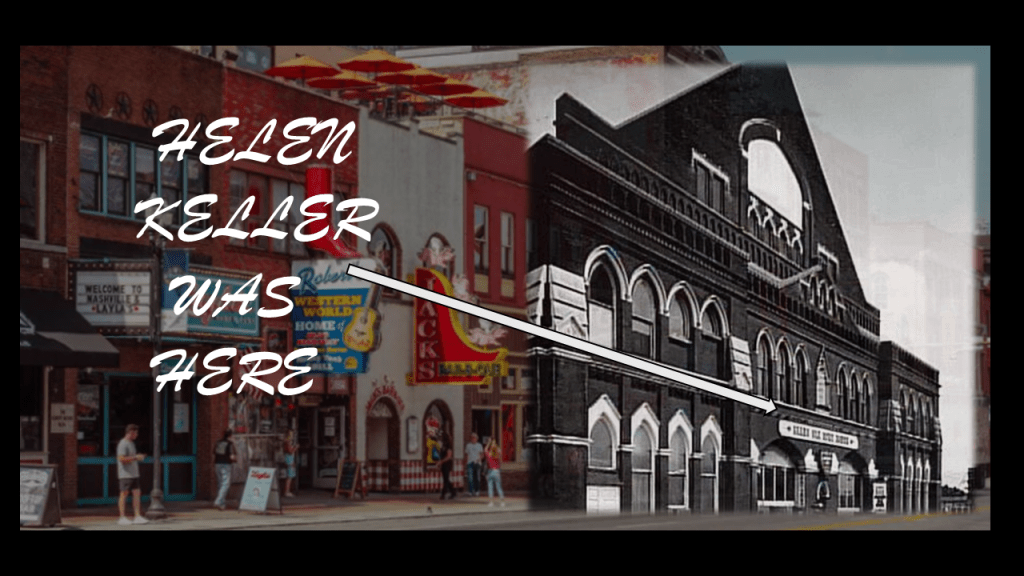
We talked about the hallowed musical ground of the Ryman Theater (located in Nashville) and the musicians who planted roots there: Hank Williams, Johnny Cash, Maybelle Carter, Earl Scruggs, and Lester Flatt, to name a few. Hell, Helen Keller did a gig there. I’m not kidding. They sold the place out.
Keith was not aware Helen Keller played the Ryman.
“Oh, yeah. She was the lead vocalist for Helen and the Hussies. All girl group. They were the Go-Gos of their day. Eleanor Roosevelt on trombone, Mother Teresa on banjo, Indira Gandhi on bass drum, Harriet Tubman on electric cello, and Lizzie Borden on chainsaw. Hindu/Mexican punk band. Their big hit was, ‘I Wanna Hold Your Hand (Over an Open Flame).’ I preferred ‘(Throw You Off) The Bridge Over Troubled Waters.’ You can’t go wrong either way.”
While laughing, he said, “Thought tha’ was th’ Andrew’s Sisters.”
My memory gets cloudy at this point because I was approaching the “I love you, Man” stage of insobriety. For the past couple of hours, I had been keeping up with Keith Richards drinking shots of Jack Daniels.
This is something you must never do.
Our conversation ran amok for a while, although we did agree to propose legislation for the permanent removal from society of the following:
1) Anyone with a mullet.
2) The DEA (Keith was quite enthusiastic about this).
3) All other law enforcement (he was fired up with this idea, too).
It wasn’t long after that I knew, thanks to the ridiculous amount of bourbon I’d thrown down, I was in serious trouble, and it was best I leave before I descended into the very unfortunate “Let’s crank up the Enola Gay” stage of drunkenness. So, I thanked him profusely for the booze. We shook hands. He said he enjoyed the chin wag and was glad I stopped by. I assured him the pleasure was all mine and would, someday, include our interaction in my memoirs. He went back to his book.
As I staggered past Smokey, I asked for a glass of water as though that would undo any of the damage.
“Uh, um, yeah, Smokey. Wondering if you could help a brother out. Do you know when the next flight to Western China leaves? After two minutes of careful consideration, I’ve decided it’s best for all concerned for me to become a Tibetan Monk immediately. I see no alternative. I’m in deep, and I think I could very well sober up in a Buddhist Monastery in, oh, I dunno, ten years. More water?”
Smokey smiled and gave me a refill.
“I’ve always been interested in Buddhism. Is that the one with Vishnu or something? No? That’s Judaism. I always get those two confused. Anyway, off I go to become a Buddhist Jew. Could you tell me where the door is?”
Smokey laughed. “Yeah, mon. Dat way. You walk good, yah.”
I plopped down $20 on the bar and walked off singing, “I’m a Poor Wayfaring Stranger.”
How I ever made it back to my hotel room is anyone’s guess. I have no recollection. I woke up on the floor. The room was very neat. The housekeeping person must have worked around me. It took a week for my head to stop feeling every air molecule hitting it.
To this day, I believe conversing with Keith Richards is a noteworthy resume item. He was friendly, elegant, extremely well-read, and very British. He wore his heart directly on his sleeve.
In 2018, I saw the Stones in concert. Keith wore a woman’s blouse, a multicolored bandana, black jeans, and green sneakers. Keith Richards is the only adult male on the planet who could make an outfit like that work.
That night, the Stones opened the show with “Sympathy for the Devil.” Jagger stepped onto the stage and sang the first verse behind just the percussion and piano. Keith then strolled to the front of the center stage. As Jagger got to the refrain, Keith let loose with a dozen riffs that knocked the audience back by five feet. He casually walked to the drum riser and lit a cigarette when done. There was, of course, a law against smoking in the venue, but no one seemed very anxious to tell Keith.
His guitar playing that night was extraordinary.
And he looked so cool.
—THE END—
* Those are lines from a Peter Falk movie. They sound lame. They look lame on paper. But they’re funny when Peter Falk says them.
° [02/23/2024] This was written before Charlie Watts died. It was easy for me to see that Keith thought the world of Charlie. He adored him and must have been devastated by his passing. The Stones are carrying on with a new drummer, Steve Jordan, who’s fabulous. But he ain’t Charlie Watts. And the band ain’t the same.
[07/15/2024] I saw the Stones a month ago. Keith increased his concert coolness factor in this author’s eyes.
When it came to music and instrumentation, Keith was in charge. He set the rhythm and tone during the concert. To his credit, he didn’t care if anyone noticed. His cues to the band were in the form of quick glances, nods, and, often, nuances in his guitar playing. Keith was not hopping up and down showing he’s the leader.
Presumably, his ego is big enough.
He didn’t pose. Too many guitar players make a big show of hitting a power chord. It’s annoying to watch some clowns make an elaborate production out of playing an E-chord. Hell, I can play an E-chord. It’s not that big of a deal. Save that shit for nursery school. Keith will hit a riff hard, and the most you might get is a slight shoulder shrug. No showboating. More coolness.
Plus, he’s the rock and roll version of Count Basie, where less is more. Keith’s a charter member of the “Why Play Two Notes When One Will Do” school of musicianship. I don’t believe I’ve ever heard him hog the musical landscape. His guitar was upfront in the mix, but he left ample room for the band.
Finally, he never plays a song the same way twice. There is nothing robotic about Keith. He’s not phoning it in. I like that.
Yes, he puttered around like an eighty-year-old during the show. He had to sit to play the intro to one song due, most likely, to osteoarthritis in his fingers. Either that or his back hurt. When you’re over eighty, there are any number of reasons to sit down. He’s got a gut, and his hair (all grey) is thinning.
But the boy sure can play.
 BOOMER(S) GONE WILD!
Leave a comment