
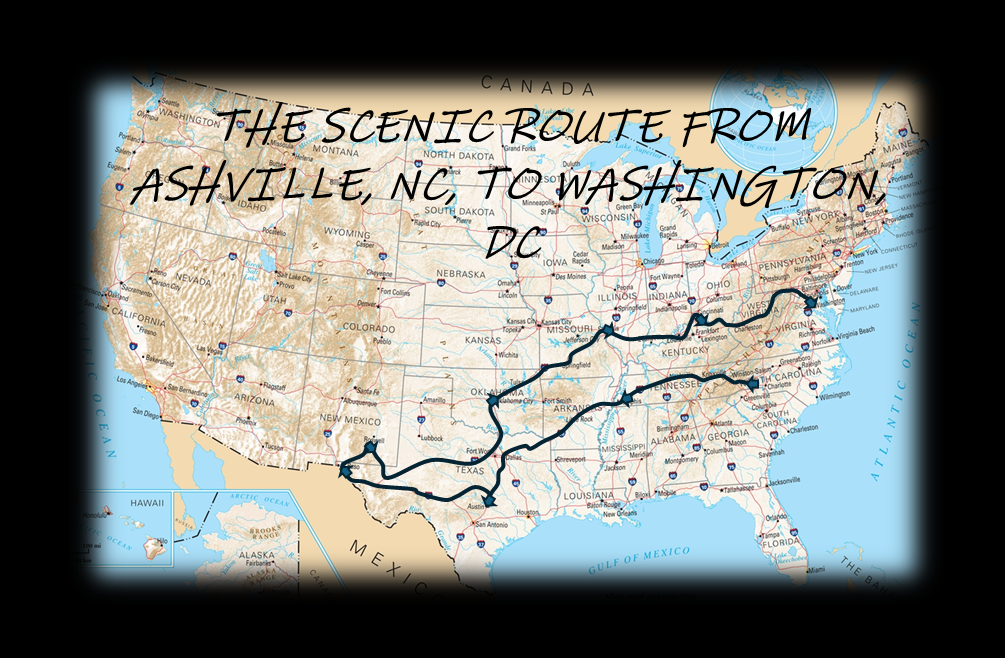

My Honda 750 was gassed up, and thanks to the moonshine, I was gassed up, too. Washington, DC, was four hundred miles to the north, and I was ready to go.
So, I went west.
I didn’t want to go home.
Thinking I’d spiral out of control if I returned to DC, I decided to visit Austin, Texas. Another counselor at camp attended the University of Texas and couldn’t speak highly enough about the place.
Based solely on that recommendation, I went to Austin. I saw it on the gas station road map, which was a good sign. The interstate highway system in the States wasn’t nearly as developed as it is today, but it was a simple route.
The journey took me from the rural intrigue of Asheville to the home of the Grand Ole Opry, Nashville, TN; then to the musical hub of Memphis, TN; the historically blemished Little Rock, AR; the developing corporate monolith of Dallas, TX; and finally, to the cultural haven of Austin, TX.
Including stops, it took nine hours to arrive in Memphis, close to the halfway point between Asheville and Austin. This was very exciting because I heard fantastic things about Memphis. It was the home of Sun Studios. Elvis Presley, Howlin Wolf, BB King, and Johnny Cash, among many others, recorded music there. Elvis lived in Memphis. Beale Street, sometimes called the home of the blues, was there. The Rolling Stones had a song about a “gin-soaked bar room queen” from Memphis. She sounded like quite a girl.
Maybe I’ll stop by Elvis’ place to say hello, chat with BB King, and stop by Sun Studios to trade war stories with whoever is cutting a song. There’s the barroom queen, of course. That’ll be fun.
It was early evening. I found a motel fifteen miles east of Memphis.
The sign in front of the motel proudly exclaimed, “Rooms. Free AC. TV IN ROOMS. Clean towels. $7/day. Hourly rate avail. No drugs. Pets cost extra.”
Well, that’s efficient advertising, free of pretense or false promises. You have to give them points for that.
The motel may have had a name, but there was no mention of it. Cheap motels could have been marketed better in 1977. I don’t think there are nameless, cheap motels anymore. My guess is they were all purchased by Marriott or Hilton. The cheap ones are now called “Best Econo Comfort Inn Suites Holiday Hampden Express Western Lodge Resorts by Hilton or Marriott maybe Radisson.”
At least you know the place’s name. The boys and girls in marketing decided to make the one-star dumps sound less dumpy with the elaborate new names. Of course, the daily rates for the dumps have increased by 2000% (before state tax, room tax, usage fee, convenience charge, service fee, concierge service, housekeeping charges, and mandatory tip). That $7/night room now runs $140/night. Nothing has changed. It’s the same room with the same fleas, bed bugs, rats, mold, water damage, and devastating fragrance of urine. However, $140 is still a great deal compared to the $300/night for hotel rooms that distinguish themselves by having fewer cockroaches. When you consider the five-star hotels run for $600/night, that $140 price doesn’t look so distressing.
Of course, you will enjoy the $600/night hotel benefits you’ll never find in the lesser-priced ones.
Such as:
– Rooms with minimal semen-stained evidence (not counting the curtains, of course).
– Remote check-in, which never works, but you give them points for trying.
– Mini-bars with shot bottles of liquor at aggressive (and offensive) tiered pricing (Stolichnaya—$28 each, Smirnoff—$21 each, Burnett’s—$18 each (bad idea), Nail Polish Remover—$12 each, Deep Eddy Ruby Red Grapefruit Flavored Vodka—$11.95 each).
– A hot breakfast you make yourself with a waffle iron that either sets the waffle on fire or causes the waffle to stick to the waffle iron to the degree that you spend twenty minutes attempting to scrape the waffle off the waffle iron before giving up and going to McDonald’s.
The American economy continues to flourish thanks to ingenious modern marketing practices that have increased the price of everything by 2000%.
I walked into the nameless motel’s lobby to check in. No one was in sight. I made the usual noises to prompt a response. Looking for signs of life, I walked around the motel’s exterior before returning to the lobby. When I was about to leave, I heard a toilet flush. A five-foot tall, five-foot wide gentleman shuffled to the front desk. He had a cigar butt in his mouth. His shirt had sweat stains, coffee stains, and cigarette burns that dated back to the American Revolution. His body odor was a cross between whiskey and wet mulch. He pulled a hip flask from his back pocket and drank a shocking amount of whatever was in the hip flask.
After expelling a Herculean belch, he said, “Uh, room. Sev-fitty wif tax. Carryin’ drugs?”
“Nope. A little moonshine. Would you like a shot? It’s intriguingly good.”
He perked up. “Yeh, much ‘bliged.” I poured some into the glass he shoved at me. He threw it down in under one second. “Whoa. Damn…sh…dat goo.”
I gave him the entrance fee, and he gave me the room key. The shot of moonshine allowed me to forego the $20 deposit.
The air conditioner was a wall unit. It worked. The fifteen-inch black-and-white TV could pick up a couple of stations. For my convenience, a copy of the weekly TV Guide assisted in navigating between the two channels by providing one-sentence descriptions of each TV show and movie scheduled for broadcast. However, the descriptions were worthless because the writers didn’t watch any of the TV shows for more than two minutes before writing about them.
For example:
Ben-Hur: A slave races in a chariot.
Or,
M*A*S*H: Soldiers get shot and go to the hospital.
That’s all you had to work with using the TV Guide.
If TV Guide is still with us and if you’re the TV Guide hiring manager for the “worthless sentence writer” position, sign me up! Here are some samples of my worthless sentence writing:
When Harry Met Sally: A woman has an orgasm during lunch.
Passion of The Christ: Jesus has a crappy day.
Never Have I Ever: An annoying high school girl tries to get laid.
Thelma and Louise: Two women drive off a cliff.
Some Like It Hot: Two guys dressed in drag hop on a train where they meet this bimbo they’d also like to hop on.
The Irishman: Don’t know, I slept through it.
Cruisin’: Al Pacino acts gay.
Selma: People walk around in cities that suck.
Finnegan’s Wake: Your guess is as good as mine.
One Flew Over the Cuckoo’s Nest: A guy gets a lobotomy.
The Godfather: Anyone who isn’t dead goes to Italy.
Taxi Driver: A cab driver gets a mohawk, gets shot, falls into a coma, wakes up, and goes back to work.
Basic Instinct: A woman forgets to put on panties.
West Side Story: A boy and a girl get the hots for each other, but it doesn’t work out.
Apollo 13: People sit around while a spaceship crashes into the ocean.
The Death of Stalin: Stalin dies.
Sybil: A weird girl gets an enema.
Weiner: Really? We don’t need to go there.
Rudy: The worst player on a football team gets on the field for one play, and everyone thinks it’s a big deal.
Back to Memphis…
The following day, filled with enthusiasm, I went on my holy journey to visit Beale Street (the home of the blues), Sun Studio, Elvis, and the barroom queen.
Disappointment followed.
Memphis experienced some tribulations in the mid-1970s. The city tried desegregating the public schools, which resulted in all the white families taking all their white money and getting the hell out of town. Memphis, at that point, had a problem on its hands as white people amounted to 60% of its population but accounted for (guessing) 90% of the money. The impact was substantial.
Beale Street was a ghost town. Blocks of destroyed buildings cluttered the surrounding area. I rode through the area, wondering what happened to all the musicians who had been run out of town. I stopped by Sun Studio, but there was no Sun Studio. The building was used to store appliances. Elvis Presley’s home was enormous. Ridiculously so. The mansion looked like a parody of itself. Inside the gates, seedy-looking people wandered around. One person tossed litter on the ground. Another drove a cart around the estate, drinking a beer. Elvis was on tour so no one bothered to maintain the place. No one bothered maintaining Elvis, either. He died a few weeks after my visit.
The barroom queen probably left for greener pastures.
I left mid-morning. I hoped to make it to Austin but exhausted my supply of motivation and moonshine in Waco, Texas. I found a diner and ordered the “Texas Chili” with cornbread because that was all they had. The “chili” looked suspiciously close to “cubes of beef in brown liquid.”
After dinner, I stopped by Baylor University. Considering it was mid-summer, there were plenty of students on campus. A great wad of them had assembled around a building. Setting foot on campus was a transformative experience as I left the dirty little podunk town of Waco and suddenly entered Seahaven (the fictional city in The Truman Show).
The campus was spotless and manicured. I’m not sure I should write this because it is shocking and runs contrary to every principle upon which this great country was built, but the students were, and I’m going to be blunt, polite. Yes, you read this correctly. Polite. The college students, that is. They were polite. It gets worse. Every sentence they spoke to me was punctuated with “Sir” even though I was their age. I hate to admit this, but eye contact was involved. The kids were well groomed. Clean, even. They bathed. With water. Soap. Shampoo. I felt dirty because of all the cleanliness. The girls wore long skirts. The boys had tucked-in shirts and government-issued haircuts. No booze, no pot, no group sex behind the dumpster, no broken Jack Daniels bottles, and not a single “Eat Shit” bed sheet banner hanging from a dorm window. Nor did I see any students face down in the dirt, thanks to the eighteen shots of tequila earlier that day.
The student wad was in front of a church as the service had concluded. It was Tuesday.
What the hell? Am I on another planet?
What is this church doing on campus? What is this church doing on campus with all these students in it? Does the chancellor know about this? The governor?
It’s Tuesday. Is someone dead? Getting married?
And why are you bastards being so polite?
There were no signs of a casket, and I didn’t see any rice getting tossed around.
This was 1977. AD. No All-American college permitted a church on campus. If it did, the place would have been boarded up (as was the case with the church on my college’s campus). Any attempt to enter a church (on or off campus) would have required your presence before the committee for student conduct, which would review your fitness to continue at the university.
As far as higher education was concerned, this place was an insult to every time-honored value that this country had.
Where were the students who hadn’t changed (or washed) their clothes in twelve days? Where were the ones who respected the status quo by wearing jeans that were ripped to shreds and proudly displaying their “You Suck” t-shirts? What happened to all those Political Science majors who were protesting the US’s involvement in the Vietnam War even though the US had pulled all its troops out of Vietnam two years earlier? Who allowed this excellent behavior by college students?
I had pretty short hair and a tightly trimmed beard, so by appearance standards, I fit in. After a few brief and friendly conversations with some rogue church-going types, I discovered that their political leanings were, by a large margin, right of Barry Goldwater. Some folks talked about their mission trips. Others were tending to youth groups. A separate group mourned the unholy direction of the country.
Huh?
You people are flaunting your hatred of the sacred and holy values this country holds dear and spitting in the face of this great country! Indecent in all your tacky decency. You…ANIMALS!
As it turns out, this was, and, I guess still is, Baylor University’s mode of operation: run a conservative Christian school for conservative Christian students. Of course, there’s another side to all of us. I wondered if this was similar to Japan, where the surface looks clean, peaceful, respectful, and above-board, but beneath it lies massive, uncontrolled corruption, misconduct, and criminality.
Where are they in the spectrum? Who knows. They don’t. That’s for sure.
Now that I think about it, there probably wasn’t much of a dark underbelly. From those I met, I didn’t detect the worldly view necessary to develop an authentic dark side.
A happy young couple encouraged me to write something on a massive canvas outside the church. It contained nice, happy-happy, joy-joy quotes about how great everything is. I saw some Latin quotes and remembered a few Latin sayings.
Well. How about ‘tete futue (loosely translated: fuck you)?’ No, be nice. ‘Te futueo et caballum tuum (fuck you and the horse you rode in on)?’ Ah, ‘disciplina presidium civitatis (a cultivated mind is the guardian genius of democracy).’
I knew that last one only because someone told me that it was the motto for the University of Texas, which was, for my convenience, in Austin. I wrote it. No one recognized it. I gave what I remembered the translation to be. I received a luke cold response.
But they were all polite about it.
I bid the wad of students adieu, “Well, you’ll be the guardians of democracy. That’s going to be a full-time job. Good fortune in school. Have a great time.”
One girl’s response, “Yes, Sir. And, God bless.”
Honey, you are killing me with this “sir” hoo-hah.
Fully fortified by whatever I ate for dinner and a new bottle of Jack Daniels, I left for Austin.
Let’s talk about alcohol consumption. Mine, in particular. At the time, I was what doctors might informally classify as a “currently-functioning alcoholic.” That designation is an artful way of saying, “It’s only a matter of time.” I was able to perform day-to-day tasks despite drinking during all waking hours.
In my unlearned view, alcohol improved my functionality. I was able to socialize, reduce my anxiety, focus on whatever task was at hand, and discover the humor in life. In my defense, warped though it may have been, my belief had some basis in reality. My best academic accomplishments were while I was drunk. So was my radio and TV work. Not shitfaced. I was just looped.
So, that helped.
I averaged a pint of bourbon a day.
I kept it to myself. People around me may have known, but I doubt it. Of course, my episodes of psychosis slowly increased. Still, I managed to convince myself it had everything to do with my moral and intellectual ineptitude and was unrelated to all the alcohol.
When you’re drunk, you can convince yourself of anything. Especially if that “anything” makes your life more convenient and is something you can justify to yourself.
North of Austin, I found another dump of a motel, rented a room and fell asleep for fourteen hours.
The next day, I showered, did my laundry, packed up, and drove to downtown Austin.
As US cities went in the mid-1970s, Austin was quirky, calm, and easygoing. It had a limited corporate presence (IBM and Motorola set up shop in Austin but little else). Otherwise, the rest of the town seemed unaffected by the real world. The local flavor included weird retailers, down-home restaurants, and a regional mix of the blues, R and B, rock, country, folk, and Cajun music.
It felt like home.
Austin was, and is, the home of the University of Texas. It was there that my faith in college students was fully restored after enduring the shocking behavior of the Baylor students a day earlier. The youngsters at the University of Texas dressed like shit, looked like shit, and acted like shit. The campus appeared to have recently hosted a soccer riot. Beer bottles were strewn around. I was greatly relieved to see those beloved, All-American, traditional values of college life were alive and well after all. Baylor may have been an aberration, but it served as a reminder of what could happen in our institutions of higher learning if we aren’t vigilant.
I saw the university’s tower where some happy camper, having climbed to the top, gunned down fourteen people.
So, that was fun.
The only conversations on the entire campus concerned the state of the school’s football team. The team’s record in 1976 was five wins, five losses, and one tie, which caused panic and animus. I experienced numerous animus sightings—big piles of animus among the broken beer bottles and dead condoms.
Now, five and five isn’t much to write home about. On the other hand, I don’t think it’s “teeth gnashing” worthy. It’s as average as you’ll get.
For the natives, though, this was simply horrifying and unacceptable under any circumstance. The consensus was that it was entirely the head coach’s fault. The guy was a clown, knew nothing about football, and had no business ever being a big-time college coach.
I was familiar with the state of college football. I knew this was the same head coach who, in 1975, led the team to a 10-and-2 record, which was, given the level of competition, getting it done. In fact, from 1969 through 1975, the team, with the same head coach who couldn’t run a pee-wee team, had a record of sixty-five wins and fourteen losses. This coach’s team won approximately 82% of its games. Plus, the team won two national championships.
Are you detecting a lack of competence with the head coach?
Neither am I.
Chances are the coach was let go per the instruction of the school’s donors. College donors are a demented and unhinged bunch. They throw tons of money at a school’s football team. However, the amount depends on their mood and the football team’s previous year’s performance. Our “not-for-profit” state universities rake in piles of cash from donors. There are few, if any, steps university administrators aren’t willing to take to keep donors, including a variety of unmentionable favors.
The behavior of those on the University of Texas campus reinforced my opinion that the greater the enthusiasm a fan has for his or her, the less likely he or she is to know what the hell he or she is talking about.
Football is a complex game at the college and professional levels. The offense creates intricate plays, and the defense adjusts accordingly, making the game highly strategic. In the huddle, a quarterback may call, “Three by two blue right ninety-five Y cross slot post wheel roll-right tight F X stick on two.” Once the offense lines up, the defense may show a split safety match adjustment on the three by two with cover seven stubby three buzz mable on the trips side, a MEG on the number one, and the apex ready to carry the number two vertical.
The play the quarterback just called may work. However, reset, the defense has changed to a blitz zero look, which is bad news and would require the quarterback to audible into a different play. That’s because the formation was three by two, so there won’t be adequate time for the routes to develop, as the unblocked rusher has an easy angle to the quarterback. The defense will be in a match man banjo to handle crossing routes. You could audible to smash, but if it’s third down and you need more than seven yards, then that may not work because the corner on the strong side will drift off the under. Sticks might do the trick. It depends on how deep the secondary lines up. You definitely don’t want to run a mesh because the A and B gap rushers on the slide side will drop to the curl zones, which will create a problem since you will only have time for a three-step drop. As the quarterback, if you decide to stand in there against a blitz zero and wait for the number three to get open on a sluggo, then make sure your life insurance premiums are up to date because you’ll soon be excessively dead, thanks to the free rusher who is playing a five-technique because you don’t have time to change formation. I once saw the Baltimore Ravens resort to a bubble screen in eleven personnel against a blitz zero, which, of course, failed miserably—the guy who called it is no longer with the Ravens.
I’m not making any of that up. Welcome to Football 101. That’s the tip of the iceberg.
During every play, each player has to be in a specific place at a particular moment and execute a unique assignment. Football plays are measured in tenths of seconds.
The American football fanatic will get his arms around none of the above. He will demonstrate undying loyalty to his chosen team by investing all his spare time in learning each player’s relevant (and irrelevant) professional statistics, college career, high school biographies, family, concurrent wives, pending criminal charges, alcohol of choice, arrest record, convictions, children and names of their birth mothers, civil complaints, gun collection, and addresses of all the foreclosures. The one thing he won’t learn is what the players do on the football field.
It gets worse. On game day, he wears a watermelon on his head, paints his body with his favorite team’s colors, proudly displays his team’s logo tattooed on his penis, wears a helmet (over the watermelon) that holds three cans of Schlitz Malt Liquor with enema tubes running from the cans to his mouth, a six-foot long foam finger with the words scrawled “Kill the Buckuners!” (assuming his team is playing the Buccaneers that day), displays “GREATEST CHEFS FAN EVER” painted on the side of the car (assuming his favorite team is the Chiefs), has “I hate Stealer Fans” (assuming he hates Steeler fans), calls in death threats to the other team’s coach (assuming the coach accepts collect calls), spends his child’s dialysis money on his favorite player’s autographed jock straps, writes “WERE NUMBR ONE” on his torso, continually sings “Seven Nation Army” until the kickoff, loses bladder control after the kickoff, and celebrates every touchdown with a dance that involves removing his pants.
Imagine how he’ll absorb information concerning the offense running three by two blue right ninety-five Y cross slot post wheel roll-right tight F X stick against a cover seven stubby three buzz mable defense.
It’ll be a quick conversation. Once you’re done explaining the strategy to this fan, he will respond with, “Whatever. The coach still sucks. Look, I gotta go get Patrick Mahomes to sign my colon.”
Back to Austin…
I heard a crowd of students bitching about a Texas player sitting out the third game of the previous season. The third game of the season took place in September 1976. Ten months later, they’re still whining about a player missing a game.
I asked a few of the students lingering on campus if there was a nightclub they’d recommend for frivolity and meaningful conversation.
The first response I received was, “They shoulda fired that coach after the Boston College game. Boston College could beat us, but they couldn’t beat Villanova! I can’t believe they talked me outta firebombing his house. We coulda been ten and one.”
Another person told me, “Who cares? They got rid of that no-damn-good coach. Son of a bitch shoulda killed himself. Bastard. I can’t believe…hey, come back here.”
Two people, between bong hits, suggested a club called the Armadillo World Headquarters for live music. They found the place appealing because you could get high there, and no one would hassle you about it because plenty of local police and politicians got high at the Armadillo, too.
So, I went to the Armadillo, an open space with a tin roof. That night, there was a double bill. The headliner was a band called Moxy. The warm-up band was AC/DC. Yes, that AC/DC. I had never heard of AC/DC, and I doubt anyone else in the Armadillo had, either.
AC/DC was, and maybe still is, a somewhat derisive term for bisexuality. We didn’t know what to expect. Well, AC/DC took the stage and played a forty-five-minute set that burned the Armadillo to the ground. They shredded the place. Raw power. Maniacal, balls-to-the-wall energy. Heroically short on subtlety and nuance. After their set, I shared a glance with the guy next to me, and we both asked simultaneously, “Did that just happen?”
Moxy had the misfortune of playing after AC/DC. They didn’t stand a chance in hell. Anything short of the Rolling Stones was doomed by comparison. The lead singer should have said, “To hell with it. Let’s go home.”
I left early, slept the night, and began my ride to DC. Thirty minutes into the ride, I melted down. I pulled off the road, stomped around, hit my head repeatedly on a metal barrier, thought about jumping in front of one of the oncoming cars, and screamed at myself, “Evil, evil, evil! You idiot. You sub-human. You weak, pathetic pile of garbage. Too stupid. You can’t do a damn thing right. Garbage! Worthless idiot. Any decent society would’ve stood me in front of a firing squad years ago. I don’t even have the courage to kill myself. Idiot, fat, stupid, ugly. Die! Die! No good. Too stupid. Disgusting pig!”
This healthy monologue went on for quite a while. Blood was trickling down from the top of my forehead.
This sort of behavior was hardly unusual. Sometimes, it occurred daily, and sometimes, it happened once a week.
I can’t go back to college. I can’t. There is no way I’ll survive ten minutes there. I’ll go insane. I am insane already. I can’t go back. I just can’t. I’m a coward. I can’t go back. I’m too stupid.
Standing on the side of the road until the end of time may not be a good idea. Next exit, go west.
The first exit I encountered was Highway 29 in the little hamlet of Georgetown, Texas. After gassing up and getting a reasonable supply of Jack Daniels, plus some band-aids for my forehead, I headed west for parts unknown. The destination was of no consequence. It was a matter of running away.
And I’m never coming back. Gone for good.
I stayed on Highway 29 for about a hundred miles until I reached Mason, Texas, another thriving metropolis. There’s not much going on between Georgetown, Texas, and Mason, Texas.
I thought you should know that.
I saw a dam. That was interesting. Relatively speaking, the dam was interesting.
There were more than a few disturbing stories floating around about the lousy juju between out-of-staters and members of the Texas police, to say nothing of the stories about the unfortunate encounters between out-of-staters and Texans who weren’t with the police. The encounters didn’t end favorably for the out-of-staters, so I rode at a family-friendly speed and was ridiculously polite to the other drivers.
I entered a new highway at Mason, Texas. I don’t remember the name of the road, but it’s probably “route something.” That should help you find it. Four hundred miles later, I arrived at the bustling urban hub of Van Horn, Texas. As action goes, it’s a little weak between Mason, Texas, and Van Horn, Texas.
You should know that, too.
There is a military base along the way. I didn’t drive onto the base because I thought there might be some sort of security due to all the ammo and stuff that had every likelihood of exploding.
I had been teetering on another meltdown and decided to ride, thinking that if I kept going, I wouldn’t enjoy another episode, even though the last one took place while riding on my untrustworthy motorcycle.
Fifty miles before landing in El Paso, I fell apart.
Again.
It was a rinse-and-repeat episode. I screamed, “I hate you,” close to a hundred times.
Eventually, I arrived in El Paso, Texas. I found a gas station, performed some bike maintenance, and stopped by a bar for a couple of beers.
The bar proudly displayed the heads of animals on its walls. The bartender’s first question was, “Done any hunting?”
“Uh, well, once. I did some bear hunting at the National Zoo. Bears were difficult to shoot. Children were everywhere. Collateral damage. They were turned into couch cushions, so it wasn’t a total loss. Actually, I tried my hand at deer hunting once. I was no damn good and was politely told to get lost. Budweiser?”
He pointed at an animal head. “I got that one in the Congo. It’s almost extinct. It took days to find it.”
How about that Budweiser, Chief? I don’t care that you hired some poor Congolese gentleman and forced him to drive all over the country so you could find some animal minding its own business and shoot it in the ass.
He announced, pointing at a bear head, “Got that bad boy in the Canadian Rockies. Tough sum bitch. Had to kick some ass to bag it.”
You didn’t kick anyone’s ass. You sat on yours.
I was nice, of course. “You’re a busy man. I hope the Canadians didn’t mind. Mind if I take a Bud off your hands?”
The bartender finally did his very challenging job and put a bottle of beer in front of me. He then continued to wreak havoc upon me with his war stories. After a couple more beers, I was losing my will to live.
There was one other person in the place. He was smiling and shaking his head. He asked the bartender, “Chet! Were you able to find me a ride?”
“I made some calls. Nothing. Sorry, man. I told you it was a long shot.”
I was sick of the bartender’s monologue. I asked the guy, “Where are you heading?”
He said he was in the Mescalero Apache Tribe and was hoping to return to his reservation for a ceremony of some sort. However, he said it was over one hundred miles to the north and not worth my time to drive him there. He downplayed the ceremony’s importance, but I could tell he felt otherwise.
I said, “Look, I’m going to Albuquerque. If you don’t mind a motorcycle and can pitch in some gas money, then I can give you a lift.”
I was still feeling edgy and thought doing someone a favor might stave off the self-hate attacks.
He looked very suspicious and declined to offer. I responded, “Yeah, I guess I’d be pretty weirded out, too. That’s alright.”
I cashed out and left. Just as I sat on the motorcycle, the guy came out. “You really going to Albuquerque?”
“That’s the idea.”
He looked a little desperate. “Hey, you know. This will add an hour to your ride, but…”
“I’m in no rush.”
“Traveling around?”
“Traveling around.” I sounded defeated. “If you need to get there, then I can help you out. I’m just riding. No particular place to go.”
As he quotes a Chuck Berry song.
Tarak laughed. “Chuck Berry!”
I smiled. “Uncle Chuck!”
His name was Tarak. He was pretty laid back and likable. He said the ceremony was a “healing” for a woman whose husband died in an accident.
For reasons I’ll never understand, the good old USA of America decided to outlaw this ceremony. Well, the white people in the good old USA of America choose to make it illegal. It was another vital act on our part to bring cultures together and learn from others.
Or something.
Having completed the formalities, we took off.
Twenty miles into the rose, we passed a public book burning. We decided to stop and ask someone for the names of the books. Witnessing it was not quite as disturbing as seeing the KKK uniform in Asheville, but it was close.
What was the book? It was called, “Are You There, God? It’s Me, Margaret.” Copies were confiscated from public libraries.
Why were the copies of “Are You There, God? It’s Me, Margaret” being burned? Because the book explains menstruation and feminine hygiene. (I never read it; I just took a couple of onlookers’ word for it.)
Now, I don’t know what your position is on either subject, but I’m not sure what the problems were. I mean, one is an inevitability. You’d think some information on this subject would be helpful for a girl. As far as feminine hygiene is concerned, do you have compelling arguments against it? From my selfish perspective, I consider it a “really, really, really nice to have.”
But that’s me.
In the good ol’ USA of America, the federal government, as far as I know, doesn’t ban books these days. Instead, we have weekly clown shows by low-level state and local politicians all over the landscape trying to get face time on TV by yelling about some book they want to be banned. The subject matter is always LGTBQ+ related.
It was worse fifty years ago. Books were routinely banned (and burned):
– “Grapes of Wrath” was banned in Kern County, California, because the book made Kern County look bad. Have you ever been to Kern County? The place is one prominent human rights violation.
– “A Doll’s House” was banned in various parts of the US on accounta it was “feminist,” what with the wife figuring out her husband’s worthless and dumping him.
– The most banned book in the US is “1984.” Isn’t that just a little ironic? The government bans a book that’s about government censorship and restriction of free speech. Plus, there’s sex in it, which causes a large segment of the American population to get its undies in a very tight knot.
According to Tarak, the last holy and sacred book burning was dedicated to “Bury My Heart at Wounded Knee.”
That news was a kick to the stomach. The best I could come up with was, “Maybe we should have a people burning.”
We left.
The ceremony had started. I dropped Tarak off. Assuming my job was done, I was ready to head to Albuquerque. Tarak asked me to wait for a moment. I figured he was going to give me some gas money. Instead, he spoke with a few of his comrades, walked back to me, and asked, “Have you ever tried any Peyote?”
“Now, that’s a question I didn’t see coming. I tried it a couple of times. A long time ago. Why?”
Tarak invited me to attend the ceremony, which involved a little Peyote as part of a communal act of healing. I could participate if I wanted.
Considering all that we Americans have inflicted upon the Apache people, I was taken aback by his invitation. How could he ask me to participate in a ceremony, knowing the history of my people’s actions towards his? It was a surprising and unexpected request.
How could I possibly say yes? My people had set out to destroy his. They’re not going to roll out the welcome mat. But how could I say no to such a significant invitation?
“Thank you, Tarak. I don’t want to intrude. I…”
“I told them I got here only because of you. You are welcome here. Come.”
“Well, uh, I’d be honored. But, uh, I’m feeling a little wigged out and…”
“Come. We all come to heal.”
“Thank you.”
I knew a little about Peyote, of course. You ingest some, get nauseous as hell for a little while, and then enter an altered reality. My use was, as you can imagine, to get high and have some fun. Peyote in this ceremony was meant to be communal, not recreational.
We sat around the woman who lost her husband. We all did a little Peyote while folks chanted. During the nausea part of the Peyote, Tarak talked about the many other ceremonies his tribe conducted.
In Apache culture, they have a four-day rite of passage ceremony for girls after their first periods. During the ceremony, the girls have to do a lot of heavy physical and emotional lifting.
Imagine a four-day bat mitzvah.
Then again, don’t.
The rite of passage ceremony is essential in the culture and, of course, made unlawful by the US Government on the grounds that the US Government didn’t know what the hell went on during the ceremony.
We white Americans have ceremonies, too. For example, when government officials don’t understand something, the politicians all gather, hop up and down, act stupid, pass wind, pretend to be important, and make it, the thing they don’t understand, illegal.
If I understood Tarak correctly, the rite of passage helps improve the girl’s confidence and self-esteem, as women are considered sacred in the Apache world, which provided all the white males in the US Government more incentive to outlaw it.
Peyote is a hallucinogen that alters your senses and expands your brain’s standard neural pathways. During songs, you see music in colors. You touch an object and hear it. You’re out of your own body, and you have lost a lot of your self-awareness.
The experience takes you out of your equation and gets you the hell out of your way.
Once the Peyote worked its magic on the participants, the healing ceremony began in earnest. A gentleman guided us on a spiritual ride through prayers and songs to the gods. It was quite an emotionally raw experience for everyone. During the ceremony, we felt the pain of the grieving woman as well as the comfort she was receiving from others. I experienced the feelings of those around me, and they experienced mine.
By sunrise, the Peyote’s effects had worn off. I was exhausted, relieved, and relaxed. Mostly, though, I had a sense of strength and resolution. It was okay to return to school and face the fear.
Some folks had left. Tarak had someplace he needed to be. I asked him to thank those who allowed me to participate, hopped on my bike and headed to Washington, DC.
I felt the best I had in a long time. The ride was long but pleasurable, and my strength was genuine. I knew the feeling wouldn’t last, so I decided to enjoy it while I could. I made the trip on coffee and cigarettes—no bourbon, no alcohol at all.
Life looked less complicated and much more manageable.
For a while, at least, peace and order were restored in the valley.
—THE END—

 BOOMER(S) GONE WILD!
Leave a comment