
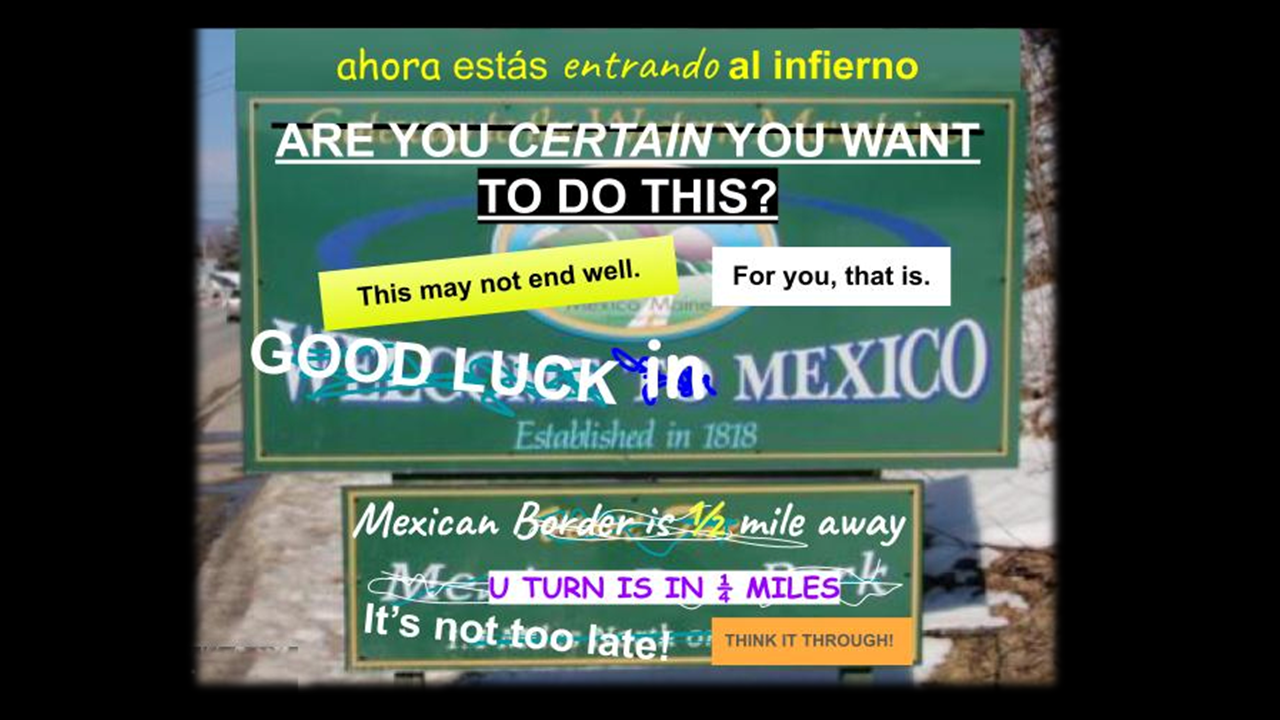
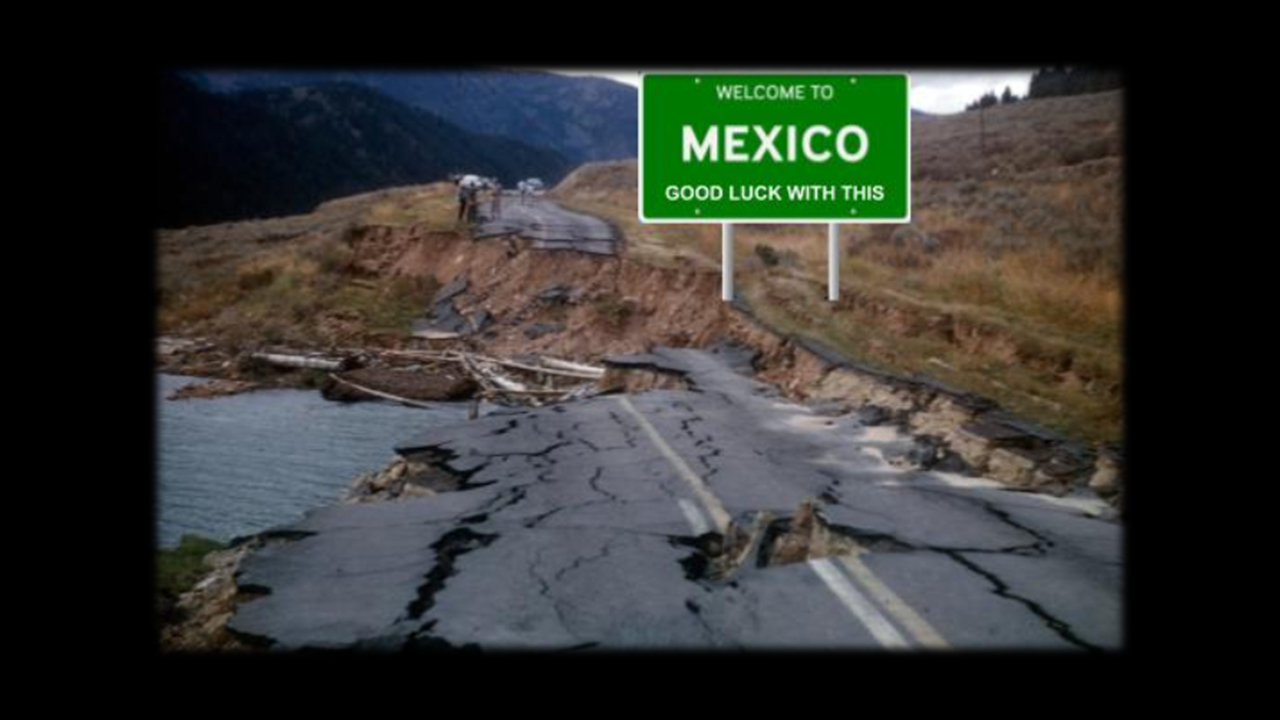
At the tender age of twenty-one, I made the mistake of driving in Mexico.
It was 1979 and I was given to understand that Mexico was just south of the good old USA of America. This is not unlike South Carolina, which is just south of North Carolina. In fact, as of this writing, this continues to be the case. I’m almost certain of it. A line on a map shows where North Carolina stops and South Carolina starts. When you’re driving down I95, there’s no line. The signs on the interstate are illegible, thanks to all the bullet holes. There’s no way to know exactly when you went from one Carolina to another. But who cares? You keep driving. People in both states speak the same language, and that language has (barely) enough elements of English to allow for some level of continuing communication. The drivers in both states share the same driving habits, such as simultaneously smoking a cigarette, drinking coffee, doing shots of vodka, reading a book, writing a book, brushing the cigarette ashes off their shirt, trying to find a station on the car radio, groping around in the back seat for another bottle of vodka, and fishing around for the cigarette smoldering on the floor.
I thought the same applied when driving from the States to Mexico. Driving is driving. It’s universal, yes?
No.
It’s not. I thought it might have helped to know what to expect. So, as a service to my fellow Americans, I wrote down a few lessons to share with other morons who assumed driving in Mexico was no different than driving in Idaho.
My helpful driving notes from 1979 read something like this:
08/01/1979, Here starteth the driving lessons.
Please read this before ever driving anywhere in Mexico.
Lesson 1: When you spot a “road hazard” sign in the States, it’s a warning that what lies ahead could be a series of events that can make your drive extremely perilous or, in some cases, nearly impossible – enormous craters in the highway, boulders that have rolled down from a mountain, or the wreckage of vehicles scattered across and beside the road. Any of these could be a “road hazard.”
In Mexico, that’s “the road.”
The roads in large cities are a mess. They’re a catastrophe in the rest of the country.
The key is not to look back and not look sideways because what will kill you is straight ahead. It’s a pothole on a bridge. All bridges in Mexico have required service since the Mexican Revolution.
Potholes run ten yards in diameter. There are two ways to navigate them:
Plan A – Build a ramp right in front of the pothole, back up a mile, then put the hammer down, accelerate to about 200 mph when you get to the ramp, and fly over the pothole just like Evil Knievel used to in his motorcycle when he’d fly over twenty-five trucks parked in a row.
This results in a total catastrophe and instant death. When Evil Knievel jumped over all the trucks with his motorcycle and landed on the other side, he’d lose control of the bike, crash, and tumble down the road, breaking around a hundred bones, crushing his spleen, collapsing both lungs, puncturing a kidney, suffering permanent hearing loss and cutting himself up to the tune of 2,500 stitches.
And he knew what he was doing.
You don’t.
So, you don’t stand a chance.
Plan B – Drive 3 mph and slowly, carefully navigate through the pothole. This results in total catastrophe and death because the pothole on the bridge is so deep that it has gone all the way through the bottom. As a consequence, you and your car fall from the hole in the bridge.
Your death won’t be quite as sudden. There’ll be a brief lag between falling through the bridge and landing on the Hacienda eight hundred feet below.
It doesn’t have to be a hacienda. It could be anything. It doesn’t matter. The moment you land on whatever it is, it’s over. In terms of vital signs, you’ll have none.
Lesson Two: Chickens. Be alert for chickens. You know how, when you see a ball roll into the street, you immediately hit the brakes? You assume a child will appear three seconds later chasing the ball. You’re usually right, of course.
“Why did the chicken cross the road?”
It’s a simple answer in Mexico: “To get the hell away from the child chasing it.”
In Mexico, children learn safety tips through a unique cultural approach. For instance, no Mexican parent needs to tell their child not to run into the street. Mexican children understand the danger of this action, having learned it the hard way when they were hit by a car while running into the road without looking. This experience, deeply rooted in the Mexican culture, taught them the importance of always looking both ways before crossing the street, a lesson they won’t forget.
So, if you see a chicken run into the road, you can assume a child, one who hasn’t yet been hit by a car, is chasing it.
The reason the kid’s chasing it in the first place is strictly due to the following equation:
Chicken = Dinner
If you run over a chicken, then etiquette requires buying dinner for the chicken’s owner and the family. The average Mexican household consists of forty to fifty family members, so this is one reason you should bring some cash before getting in your car.
Lesson Three: Don’t run over the child chasing the chicken.
Residents of rural Mexican towns practice something you might refer to as “self-policing.” This is valuable knowledge. Mexican parents allow their children to “live and learn.” They take the “live” aspect personally.
A fine example of self-policing is the National Hockey League in the 1960s. In those days, the last thing the referees did was enforce the rules. The players did. Each team had “the fourth line,” hockey-speak for “goon squad.”
The team’s fourth-line players were not a delicate bunch. Some of them could barely skate. It didn’t matter. Their job was to beat the hell out of anyone on the other team who broke specific game rules.
They were the enforcers.
One rule in hockey back then was, “If you hit my best player, then I will have my enforcer pay a little visit to your best player.” By “little visit,” I mean “crush your best player’s spleen.”
This rule was not in the hockey rule book. It was common knowledge.
You didn’t need a referee for that.
Mexicans are smart enough to understand involving the police only slows the wheels of justice. Besides, if the police happen to show up, then they’ll take everyone’s money and leave. It is better to resolve matters without the needless delays of a jury trial.
Mexican villages have their enforcers, too. When it comes to self-policing and enforcing the rules, these guys are no less subtle than the ones playing hockey.
If you run over a child, then you won’t be arrested and tossed into some rural Mexican jail waiting to go on trial. Instead, you’ll be subject to the local self-policing customs.
This also means, in terms of fitness and longevity, yours is limited. There is, of course, an informal trial. It lasts as long as it takes to kick you around for a while, drag you up to one of their bridges, and drop you through a pothole.
I’ve seen the inside of a rural Mexican jail. Death is a much more rewarding experience.
So, in a way, they’re doing you a favor.
Lesson Four: If you are an American, everything is your fault. Everything. You could legally park somewhere with no other cars within two hundred yards. If someone goes out of their way to find your vehicle and then drives into the side of it, causing the driver and all passengers to fly through the windshield, as seat belts are prohibited in Mexico, it’s your fault.
You don’t even have to be in the country. It’s still all your fault.
Here’s another example:
Imagine a man who leaves a bar after winning an all-day gin-drinking contest. He stumbles three hundred yards from your parked car and dies, having suffered from cirrhosis of the liver. This is particularly notable since he has also won the gin-drinking competition for the past 856 consecutive days.
It’s still your fault.
You see, there is a geopolitical aspect to this. Mexicans, as is the case with all countries these days, blame everything on us Americans from the good old USA of America, where the bombs are bursting into the air so we can form a “more perfect” union, which is an interesting phrase. Either you’re perfect, or you’re not. There ain’t no such thing as “more perfect” than perfect.
“Extra virgin” is another one. How is one classified as an extra virgin? Either you is or you isn’t. Or is it a state of mind? Let’s say someone propositions you, and you respond, “Thank you, no. I’m extremely not having sex yet.” Does that qualify?
Anyway, I’m not sure why the rest of the world hates us. Perhaps it is the shared view among the six billion non-US citizens on this planet that we Americans are rude, whiny, self-indulgent, hypocritical, thoughtless, uncouth, mean, willfully stupid and uninformed, cowardly, dishonest, self-entitled, shallow and pampered pigs-in-clover who possess an unconscionable unwillingness to do anything we might consider an inconvenience especially if it’s something that might assist others since we have no character.
I can’t imagine where they got that idea.
Fortunately, “personal liability” runs in an indirect variance to “the amount of American money you’re willing to pay with.” In Mexico’s case, it doesn’t have to be a lot of American money. Thanks to the Mexican government’s spectacular intrusion into the country’s financial matters, the Mexican Peso is worth four cents US.
Drop $100 American on the ground; you are no longer considered at fault. You might call this a scam. And for good reason. It is.
Lesson Five: All roads are a toll road if you are an American. The streets are not marked as such, and, for your convenience, there are no toll booths. Instead, the police identify your car is being driven by an American, pull you over, and stand next to you with a gun in one hand while extending the other hand, palm up, towards you. This is your signal to pay the toll.
How much is the toll? You have no idea. Usually, $10 US covers it. I never got any change back from the upstanding police people, so I must have guessed right.
If your IQ is hovering around room temperature and you contest the toll, then, in the spirit of protecting and serving the community, the conscientious officer will hold the gun to your head, tell you a kilo of cocaine was found in the trunk of your car even though the trunk was never opened and let you know the toll is now $100 US.
You’ve heard people talk about a “come to Jesus” moment. It’s an epiphany where your general view on a subject quickly changes from a macro level to a painfully personal one. There’s a saying, “Everyone has a game plan until they get punched in the mouth.” I’ve been punched in the mouth a few times. Trust me when I say it’s an experience that can easily change your thoughts on any number of subjects. In this case, our “come to Jesus” moment involves reality punching you in the mouth in the form of a gun pressed directly between your eyes. And it would be best if you made a hard decision posthaste.
Well, Tex, welcome to your “come to Jesus” moment. Will you stand on principle and refuse to give in to extortion, thereby compromising your health, or will you fork over the $100 and get out of there with your socks on?
I do not doubt integrity can occasionally come in handy. In this case, however, I’d cough up the cash, return to my hacienda, and throw down twelve shots of tequila.
The alternative is not uplifting. The cop will drag you out of the car, arrest you, and announce the following:
“Tú fornicando, idiota perro cerdo americano, no puedo esperar a patearte el trasero, rata bastarda bolsa de vómito!”
I don’t know what the above means, but it ain’t good as you’ll spend a happy night or two in a jail cell with fifteen guys who, for ease of identification later, are all named Juan Garcia.
Oh, and how did the cop know you were American in the first place? You were stupid enough to obey the stop signs and traffic lights. That’s why.
Don’t ever stop.
Especially at night.
If it’s night and if you ever want to see your family again, then do not stop. Period. If you stop, then you’ll be descended upon by:
1) The helpful policeperson looking for some toll money.
2) The thief attempting to take you and your car to a chop shop to sell you and your vehicle for parts.
3) The lovely and friendly dama-de-la-noche trying to take you to her boudoir, where you will be assaulted by the pimp who takes your wallet and clothes.
4) The kidnapper hoping you’re worth something on the open market.
5) The town’s mayor making sure, regardless of the outcome, he or she gets paid.
Another thing: when someone is honking at you, the driver wants you to know the car’s brakes don’t work.
Here endeth the driving lessons.
I could speak on this subject. I lived the nightmare of driving in Mexico. My first experience was driving about six hundred miles southeast of Mexico City to an unlovely municipality called Ariaga in the highly confounding state of Chiapas.
Assuming you keep the stops to a minimum and the terrain is flat in the States, you can make the journey in under nine hours.
In 1979, my six hundred-mile drive took in Mexico almost twenty hours on accounta I had to dodge all the potholes, boulders, dead people, enormous chunks of asphalt, roadkill, children (not yet dead, but it’s just a matter of time), garbage, broken tequila bottles, and father-of-the-year candidates blocking the way to have me marry one or more of their daughters.
And chickens.
What is it with all the chickens?
Chickens darting around moving vehicles.
Mexican chickens have issues. You could do exceptionally well opening a chain of psychiatric chicken hospitals (Casa de Pollos Locos). These were a unique breed of suicidal, attention deficit disordered, drunk, hyperactive, speed-balling Mexican Idiot Chickens.
I was pulled over once. I was utterly guilty. I stopped to avoid running over some child—total stupidity on my part. Mister Policeman was nice enough. It only cost me $8, which, at the time, amounted to twelve hundred pesos. I considered it a bargain.
There was a reason I went to Arriaga. I mean, I didn’t think it’d be fun to summer there. I went to visit my friends Sara and Luke. They were a couple. I met them in college. Luke was an earnest model citizen who made it a point to view all things positively. Sara was grounded, easy-going, and provided a calming influence on Luke. I had known Sara for a couple of years, and we developed a good-natured, comical, flirty banter that was easy to do because we had no romantic interest in each other.
Luke and Sara were earnest do-gooders doing do-gooder type things through some do-good agency committed to helping children of families who didn’t have two pesos to rub together. They were six months into an eighteen-month commitment. In return, the agency would finance some of their graduate school once they returned to the States.
I liked them both. I was interested to see what they were doing.
The pre-trip planning was primarily done by mail. Working phones were difficult to come by in Arriaga.
They had to drive someplace to get a phone that worked for more than 5 minutes.
Our last call before my visit was awkward:
“So, Lukey. What trinkets can I bring you from the homeland? Soap? Guns? Toilet paper? You do have toilets in Arriaga, correct? Bail money?”
“Coloring books,” was his reply. “Kids here love, love coloring books. You’ll love it here. It’s great. You’ll love the people. The beach is amazing. We love it here. We might stay longer. Sara’s happy we’re living here. Together. I think she’d stay here forever if she could. We might start a family here, too. Um, so, yeah, coloring books. As many as you can find. The kids love coloring books.”
I immediately thought something was amiss.
Hmmm, he’s trying way too hard. I’ve heard better sales pitches at mattress shops. Sara’s letters didn’t seem as enthusiastic about the place. And she never hinted at starting a family.
“Coloring books. Message received and understood. I’ll see what I can scrounge up. So, how’s the government oppression coming along? Any college students left in the country?”
“It’s not that bad. I mean, where we live. You’ll see. The government is pretty helpful. You know better than to believe the news. The ocean is amazing. The people here are great—the best. Like I told you, we love this place. Really. It’s beautiful. We may end up living here.”
Yes, I do remember you mentioning this already. Why are you talking like this? Selling time-shares? Amway? Stop all that.
“Ah, paradise, is it? I can’t wait to case the joint. What’ll ya’ll do with yourselves once you set up permanent shop?”
Luke paused. “It doesn’t matter. As long as Sara’s here. That’s the…..”
“Jolly good. And how is the Better Half? Eating well? Good coat? Not going outside the litter box, I hope. “
“Sara’s fine. Here.”
That was blunt.
He gave Sara the phone.
Folks live in poverty, but it’s beautiful. Though it’s currently at war with its citizens, the government is pretty helpful. You’re ready to live there forever. You have no idea why. And, oh, yeah, Sara’s fine.
For Luke, the glass was always half-full. He sounded like someone trying to convince me all was jolly in his kingdom even though, deep down, he knew something wasn’t.
Sara sounded much better than Luke.
“You are naughty, naughty man. Get down here right now.” I heard the smile in her semi-whispering.
“Yes, dear. So, what night do you plan on wining and dining me just so I can say, ‘No.’”
“We both know you could never say ‘no’ to me.”
“Now, look here! I’m perfectly capable of telling you, uh, yes! When do I start?”
“Miss me?” She was still speaking quietly.
“Terribly. I’ve been pining at the border and built a statue of you in El Paso. Quite stunning. Are you wacky kids thinking of laying down roots in Tierra del Fuego or wherever you are? Is that what one does with roots? Lay them?”
“Sure. I guess. Are we still handicapped with the unsuitable girlfriend?”
“Sure, I guess?” And a sudden change of subject.
“Alas, we parted. These days, I comfort myself by arising with thoughts of thee. Are you thinking of staying in Muerte, Mexico? Or whatever?
“Why not? Luke really wants to. So, yeah, maybe.”
“What am I going to do with your statue? I need to do something about it. It’s nude. Quite tasteful. Would you send me some highly inappropriate clothes that I can put on your statue? She looks cold.”
She maintained a low volume. “You’ll just have to come here for some of the real thing. Love me?”
“Eternally.”
I got the feeling Luke was rushing her off the phone. “Good. I love you. I’m getting hairy eyeballs. Get your little bottom down here now. Bye-yee.”
”Au revoir, mon cher.”
What is going on with these two? This doesn’t feel right. Not even close.
Nah, reading too much into this one. Gotta quit looking for something that isn’t there. Too many people were standing around listening to the call. Made it uncomfortable for them. If everyone seems happy and everything seems fine, accept things as they are.
However, I was terrible at accepting things as they were or were. Besides, without reservation, I understood that nothing is ever as it seems.
Never was.
—END OF CHAPTER ONE—



 BOOMER(S) GONE WILD!
Leave a comment