
Mexico, in 1979, wasn’t the healthiest place to do business. The Dirty War was still going on. Key government officials, in the name of keeping peace and tranquility throughout the country, dispatched death squads to capture the hearts and minds of the citizenry by torturing and killing thousands of people they didn’t care for. These days, the PC police prefer we refer to these as “extrajudicial executions” instead of “mass murders.” I don’t know why, either.
Suppose you can get past the mass murders. If so, you’ll see Mexico’s ruling party for most of the 20th century, the PRI, was exceptionally successful in providing its beloved citizens the benefits we associate with large, high-functioning dictatorships: economic chaos, thorough corruption, voter fraud, unbelievable incompetence, extreme poverty, property destruction, domestic terrorism, and the standard repression of free speech. I figure, at some point, half the population was under arrest. Nobody charged them with any crime. It was simply the PRI’s go-to strategy to spread more misery.
I don’t know if this is still true, but, at the time, you could get tossed in the clink if you didn’t sing the Mexican national anthem the “right” way, which speaks volumes.
And killing journalists. Oh, man, they had “extrajudicial journalist executions” down to an art form. You got your throat cut before you could even get your press credentials. It’s a tradition the Mexican government proudly supports to this day. Journalists continue to vote for Mexico as the most dangerous country in the world for journalists.
The police didn’t have time to investigate any of the murders as they were too busy committing the murders. The police recruitment posters must have said, “Tired of the day-to-day humdrum of being a decent human being? Do you enjoy killing people? Would you like to make new friends and torture them to death? If you said yes to any of these questions, we have the job for you! So, come on by and learn more today! Bring proof of criminal insanity, a positive ‘can-do’ attitude, and your prison record. Experience in homicide, arson, assault, rape, theft, B and E, kidnapping, extortion, child molestation, false imprisonment, terrorism, and drug dealing preferred. EEO.”
The word “Feminicidio” entered the vocabulary in the late 1970s due to the horrifying increase in women and girls murdered for the crime of being female. The Mexican government does nothing to discourage this. It never has.
When I decided to visit, I knew the sad state of affairs but thought it was a risk worth taking.
When packing to fly to Mexico in 1979, I had to keep a few things in mind if I didn’t want to get thrown in a Mexican jail cell surrounded by fifteen guys named, for the occasion, Juan Garcia. No music cassettes because rock and roll was banned, what with it being subversive and having naughty sex stuff in the lyrics. No books because, depending on the mood of the customs agent, a copy of “Anne of Green Gables” might be pornographic, and “The Little Engine That Could” might be a direct threat to the Catholic Church. No magazines, no newspapers, no t-shirts with words or numbers on them, no jewelry, no drugs (prescription or otherwise), no cameras, and no electronic devices, as bringing any of these things would show my obvious intent to overthrow the government. I’d end up in the big house encircled by my fifteen new best friends.
I had a year of Spanish as a college freshman and quickly forgot most of it, so I brought an English/Spanish translation book for the trip. This was my light reading on the flight. I thought about the Monty Python skit where some person writes an English/Hungarian translation phrasebook that intentionally screws up the translations. As a result, this Hungarian guy walks into a British shop to buy some cigarettes and looks at the book to say, in English, “May I buy a pack of cigarettes?” He ends up saying, “Please fondle my buttocks.”
The airliner I took to Mexico City was called “Bueno Como Muerto (Good as Dead).” The pilot must’ve had an acute central nervous system disorder. He couldn’t keep the plane straight. He’d veer to one side before over-correcting to the other side before over-correcting the other way for the entire flight. My coffee kept spilling left and right onto my shirt the whole time. Plus, altitude maintenance was a challenge. The plane would drop straight down two hundred feet for no reason other than it was the moment when I was trying to drink the coffee, so instead of going into my mouth, the coffee went up my nose. Of course, the pilot would overcorrect, causing me to spit the coffee out of my nose directly onto my pants. The traffic-stopping-gorgeous flight attendant (referred to as the air hostess at the time) was friendly enough to sell me eight shot bottles of vodka. I had come to terms with the idea that this flight wasn’t going to end gracefully, and I was fully prepared to die.
I could have prepared for my certain death by asking God to forgive my multitude of sins. I could have written a goodbye note asking everyone I knew to forgive my many sins. I could have asked the air hostess to forgive me for the sins I contemplated each time she walked by.
Instead, I got drunk.
Flying was different in the 1970s. The cabin was filled with smoke as airlines allowed smoking back then. Cigar smoke, cigarette smoke, pipe smoke, and blue smoke caused by someone forgetting to check the airplane’s oil. Seat belts were optional, enabling anyone under eight to scramble around on the aisles and over the seats to steal food from the food cart and the other passengers. The pilot was able to land the plane on his second try. He slammed the brakes so hard that anything not nailed down flew to the front of the aircraft and caused the rest of the coffee to spill on my shoes.
When it came to getting off the plane, there was none of this courteously waiting-for-the-people-in-the-row-ahead-of-you-to-exit nonsense. Passengers ran over each other to be first off the plane, which caused a great crush at the door.
Unfortunately, we had to wait while airport employees tossed all the luggage from the plane onto the tarmac, which meant all the suitcases, crates, boxes, livestock, and children were now in one big pile.
No one opened the door. The law of physics finally prevailed, and the door broke off its hinges due to the force of the crowd. Once it broke off, people burst out of where the door used to be, fell down the stairs, and landed on the tarmac. They dashed to get their suitcases from the luggage pile. Folks were crawling all over the pile, looking for their stuff. Fights broke out as people tried stealing each other’s suitcases.
Thanks to my eight little vodka shots, I wasn’t looking sharp. I was covered with coffee stains, my shoelaces were untied, my sunglasses were crooked, half of my shirt was untucked, and I had a cigarette hanging off my bottom lip. Plus, I still had coffee coming out of my nose. I wasn’t walking with a lot of purpose: two steps forward, one step sideways to get my balance, two steps ahead, one step backward to ensure I didn’t fall on my face, two steps forward, rinse, and repeat.
I found my suitcase and stumbled to the customs line, discovering no line. It was another pile of people crawling over each other to be next to get through customs. I was in no rush. I understood that, as a Yankee-Pig-Dog-American, I’d be getting special treatment from the customs guy who, once we finally met, pointed at the table and said, “Bolso. Ahora. Ahora! Abrelo! Ahora!!”
I put the suitcase on the table and opened it. The helpful and considerate customs guy tore through everything while maintaining a look of total disgust. Then he got to the approximately fifty coloring books I bought per Lukey’s request. He looked appalled. He picked one up, looked at me, and said, “Que carajo?!?!”
My rust with the Spanish language and my extensive inebriation became an issue. I knew what I wanted to say but couldn’t figure out how to say it in Spanish.
I said, “Libros para colorear, uh, sorry, uh, mierda.”
What I meant to say was, “Coloring books.”
What I said was, “Books to color your shit in.”
The customs guy asked, “Por qué?”
I replied, “Well, uh, a, uh, proporcionan muchos orgasmos a los niños.”
What I meant to say was, “Kids enjoy them.”
What I said was, “They provide many orgasms for the children.”
The guy needed clarification. “Por qué traes estos? Huh?!”
I tried to explain, very slowly, why I was bringing coloring books. I semi-smiled and said, “Uh, yeah, uh, see, engo amigos que quieren, um, enseñar y y y niños y niñas porque, uh, like, sorry, quieren colorear los libros con crayones, so,, en los libros donde no dejan arena en la ropa interior.”
What I meant to say was, “My friends instruct young children. Coloring books and crayons help them teach the children.”
What I said was, “I have friends want to teach and and boys and girls because they want to coloring the books and crayons in the books where they keep sand out of their underwear.”
The guy was dazzled by my grasp of the language. He stood and stared into the distance for about 30 seconds and finally said, “Maldito idiota. Empaca tu mierda y piérdete. Maldito Americano.”
I’ll spare you the translation.
“Right-o. Well, Muccous garcias, et tu, Bruté.”
I always try to be polite.
My point of contact was a teenager called Diego. He was supposed to hold up a sign proudly displaying my name. I walked around for a long time before spotting a half-asleep, petulant-looking young man leaning against a pillar. A cardboard sign at his feet said, “Draw.”
I tapped him on the shoulder and asked if he was Diego. He looked at me, pulled a Polaroid picture from his pocket, studied it, studied me, and, having concluded the formal identity verification process, took my suitcase and motioned me to follow. He led me through this tangled mess of cars, pedestrians, chickens (dead or alive), and street vendors before we approached something that, from a distance, looked like an antique metal sculpture. Up close, it resembled a car.
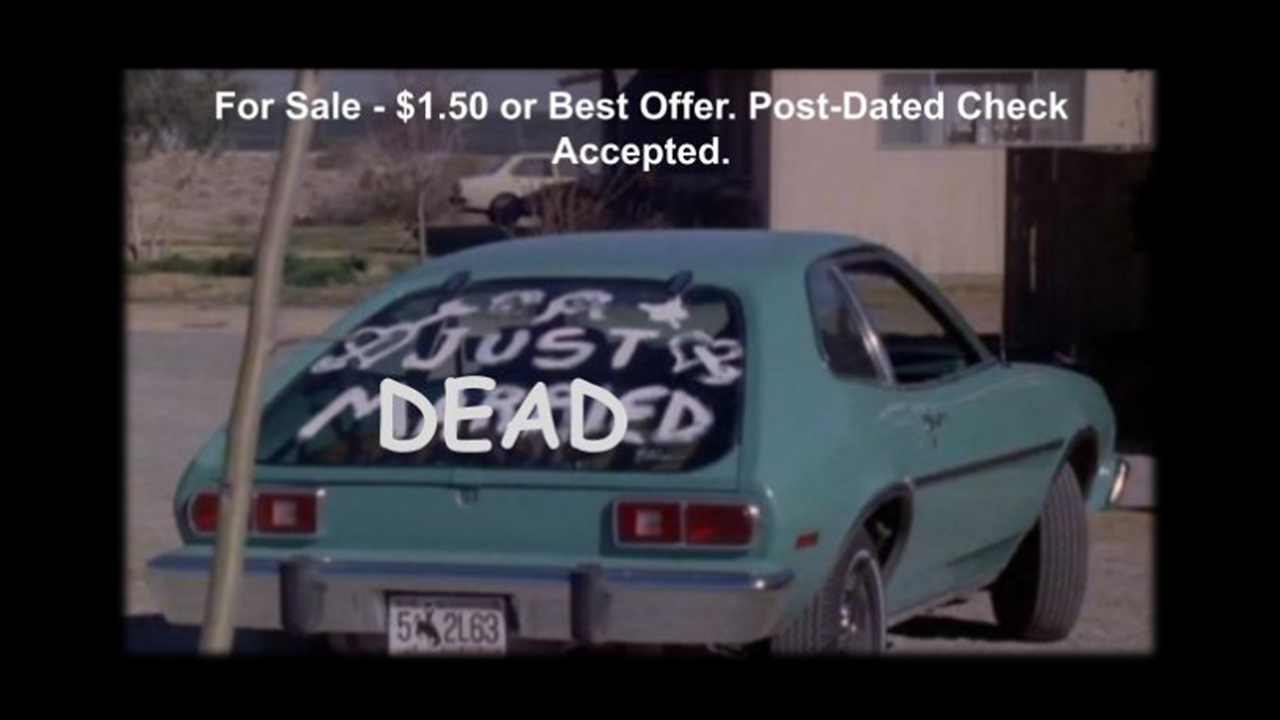
It was a car. Well, “car” might be stretching it. It was a 1972 Ford Pinto. As such, it was more a “crime against humanity” than an actual “car.”
In the seventies, American car manufacturers churned out many wretched cars: the Plymouth Violator, the Dodge Fallacy, the GMC Discharge, the Jeep Languisher II, etc. However, none of these car models came close to the dumpster fire that was the Ford Pinto.
Some unique features of the Ford Pinto were:
1) The entire body consisted of tin foil.
2) The available horsepower averaged between zero and negative four.
3) Sometimes, the steering mechanism worked.
4) If you gave it a mean look, one of the wheels would fall off.
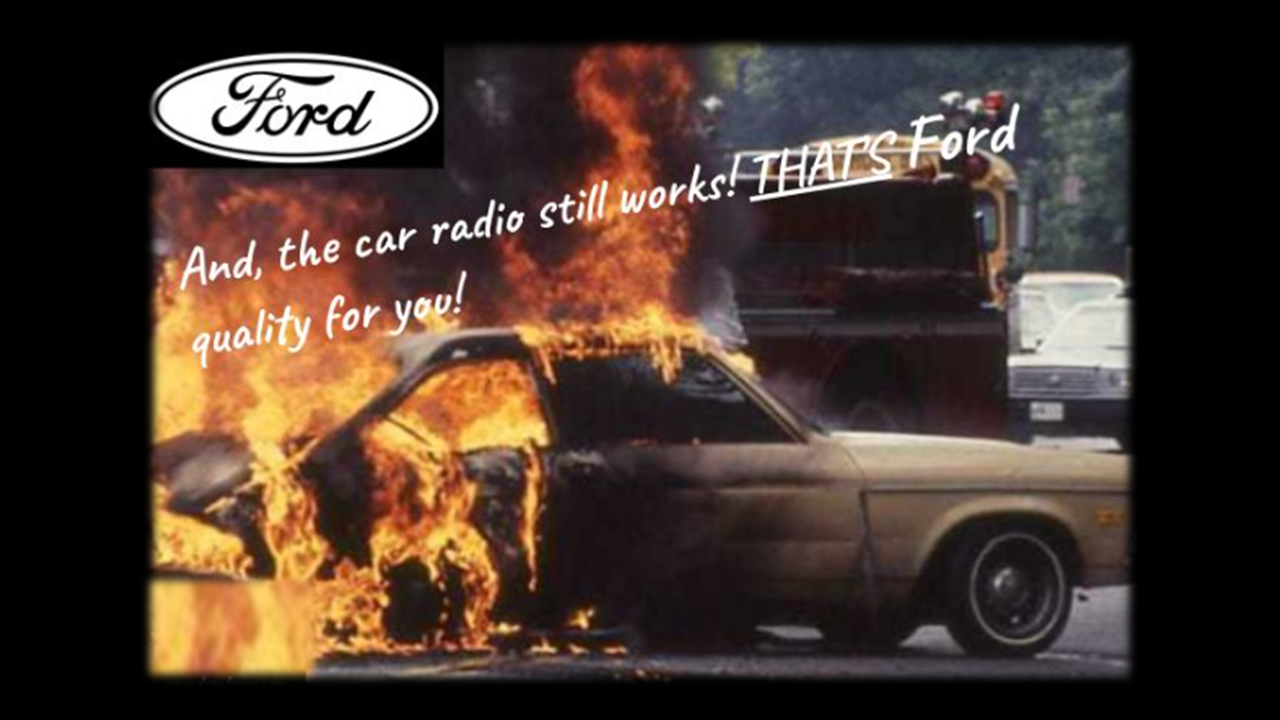
But, what really separated the Pinto from the rest of the field was that if you hit the back bumper of the Pinto at a speed over two miles per hour, the car would instantly catch on fire and, soon thereafter, explode.
As we stood silently admiring the worst car ever produced, Diego pulled a ring of keys out of his pocket, tossed them to me, and said, “Usted conduce. Estoy muy cansado.”
“Do what? Me? Drive? Uh, I mean, no puedo, no debería tener una licencia mexicana, sorry, no tengo una y la policía con pelos en la nariz terminará en la cárcel con muchas cosas Juan Gracias, malo, no es una buena, apesta.”
I meant to say, “I don’t have a Mexican driver’s license. I don’t want to get pulled over and end up in jail encircled by a bunch of guys called Juan Garcia. Not good.”
What I said was, “I can’t shouldn’t Mexican license don’t got one and police have nose hair will dead end up jail and many plenty Juan thank-yous, bad, not good, sucks.”
Diego shrugged, opened the passenger-side door, threw my suitcase in the back seat, and hopped in.
The car may have started white. That’s a guess. It was held by abundant duct tape to cover the rust and coat hangers to keep the hood from flying off the car while driving. I thought it would have made a for a great coat hanger TV commercial:
Woman: “Hey, Bob. Look at all the Johnson Coat Hangers holding the neighbor’s car together!”
Man: “You’re right, Becky! No driver should ever be without a 50-pack of Johnson Coat Hangers! You can use them to hold down the hood, be an ultramodern antenna, keep the rear doors from falling off, hold the wheels in place, secure the top from flying off, ensure the darn engine doesn’t fall out, and so much more!!!”
Woman: “Gosh, Bob. Every car owner needs plenty of Johnson Coat Hangers!”
Man: “Heh, heh. You’re so right, Becky! Johnson Coat Hangers are also great for relieving constipation, clearing your sinuses, and hitting the kids on the side of the head whenever they’re being total jackasses!”
Woman: “You know, Bob. That’s real value! They’ll make the perfect Christmas gift this year!”
Opening the driver’s side door involved putting my foot flat on the side of the car and pulling the door as hard as I could, which caused a creaking sound easily heard in Honduras.
The car eventually started and continuously shook, rattled, belched, and backfired. I drove while Diego drank beer, slept, and gave occasional directions by pointing at the next turn about eight feet before I needed to make the turn. I ran over twelve taco stands and forty chickens on the drive. I thought it best to avoid the beer while driving, so I opened a can of the Mexican version of Coca-Cola, which tasted like two-week-old, carbonated cat litter. I took one sip, spit it out, and yelled, “Cerveza, cerveza!!! Por favor!!! Sorry!!! Ahora!!!”
Diego gave me a beer. I slammed it. He gave me another.
As mentioned in the previous chapter, there was no road. It was one continuous road hazard that took forever to navigate. The car bitched and moaned the entire time. There was a severe latency issue. When I hit the brakes, nothing would happen for a couple of seconds before the brakes would start screeching, which caused the engine to turn off. When it worked, the steering mechanism had a 5-degree turning capability, so making a right-hand turn was a 10-minute proposition, requiring many stops, which resulted in the engine turning off. Hitting the accelerator produced a noise you’d associate with three hundred jackhammers. The zero-to-sixty speed could have been timed by a sundial. Plus, all the coat hangers rattled like crazy, smoke came through the air vents, the glove compartment door kept falling off, and the horn would randomly blast just before the vehicle shut off. There were no shock absorbers, so every dip in the road resulted in a considerable shock, resulting in the car backfiring and the engine turning off.
The only thing in the car the worked correctly was the AM radio, which Diego insisted on playing way too loud. This was highly unfortunate as the popular music in Mexico in 1979 was some of the most hideous crap you could imagine. Every song was a ballad featuring an awful opera singer bellowing over a few trumpets and an out-of-tune string section. The subject of the tunes was always a woman named Maria. Maybe it was a coincidence. Perhaps they were all singing about the same woman named Maria. If so, she must have been quite a girl. Anyway, the storyline of every song was how Maria kicked the singer to the curb for a guy who was deceitful, mean, selfish, and ugly but made up for it by being rich. Maria, being incredibly shallow, fell for the rich guy who was only interested in naughty things like taking drugs and having premarital sex. However, the day would come when she’d realize how miserable she was since the rich guy didn’t love her the way he, the opera singer, did. She’d return to him and come running back into his arms. He, the bad opera singer, was convinced this day would come.
I mean, I don’t know. It’s altogether possible that Maria wasn’t a total ditz. She completed a cost/benefit analysis and concluded a life of endless sex, high-class cocaine, expensive vacations, and designer clothes was preferable to standing in a pasture with cow manure between her toes in the arms of a pathetic loser.
“Hmmm,” Maria thought. “Would I prefer eating caviar, drinking champagne, and taking in a Broadway show every night, or am I better off in a house with lousy plumbing, eating beans and farting all night next to Loser-Boy while watching Celebrity Bowling on a 13″ black and white TV?”
Some decisions are easier than others.
The drive to escape Mexico City took weeks.
Most of the roads in the city had the requisite markings indicating specific lanes. Lanes on the street are easy to understand. You get in one, and you drive in it. If you want to turn left, you get in the left lane. You don’t want to take your half in the middle if you’re on a two-lane highway. Easy, yes?
No, actually.
Lanes, at the time, meant nothing in Mexico. If there was room for your car between two other vehicles, you shoved your way in. You could be in two different lanes, on a service road, shoulder, slip road, emergency road, or halfway into oncoming traffic. It didn’t matter.
To me, this presented a challenge. If you’re on the far-right side of a four-lane highway and you want to turn left soon, then you must navigate across multiple cars, none of which are in anything resembling a lane. It turned out the locals were able to overcome this by not caring. When it was time to turn left, you turned left. You could be on the right shoulder of an eight-lane highway and suddenly turn left. It didn’t matter. This made intersections a lot of fun because cars approached you from all directions.
This brings me to my next point. Intersections in Mexico weren’t called intersections. They were called “Encrucijada de la Muerte [Crossroads of Death],” mostly because half of the traffic lights in Mexico City didn’t work. Mexicans developed a clever way to manage this by, again, not caring. Every driver assumed the traffic lights were there for decoration only. So, the traffic light could be out, blinking, red, green, pink with a stripe down the middle or, and I did see this, on fire due to faulty wiring.
So, driving through the intersections was a Mexican version of Russian Roulette, except Russian Roulette is much more humane. You have only one bullet in six chambers. The chance of you not blowing your brains out is 83.33%. That’s pretty good. And, okay, let’s say things didn’t turn out as you hoped, and you failed in not blowing your brains out while playing Russian Roulette. Look, assuming you’re holding the gun directly on your head, the time between you pulling the trigger and you entering the homeland, as it were, is limited. It’s quick. Done. No mas.
Mexican Roulette was significantly worse. You had cars coming at you from all directions whose drivers had no intention of slowing down or stopping. No one’s brakes worked.
This brings me to my next point. The cars in Mexico appeared to have been active participants in World War II and had not been serviced since World War I. They all looked like the weird piece of bacon on the bottom of the package. You had cars with crushed front ends, smashed back ends, crushed doors, dents, rust, missing sideboards, broken mirrors, cracked windshields, no windshields, rear bumpers dragging on the road, bald tires, broken headlights, smoke belching from where the exhaust system used to be, mufflers dragging on the highway, more smoke coming from under the hood and sparks flying what with no brake pads (on those infrequent moments when someone applied the brakes).
Once we got outside city limits, Diego suggested a little side trip to Acapulco where we might complete a complicated transaction that involved me giving Diego some American money, Diego giving a guy the cash, and the guy giving us a healthy amount of weed. Acapulco Gold. I was delighted to oblige. I had heard good things about Acapulco Gold. I remembered Cheech and Chong’s advertising jingle on the subject:
“No stems, no seeds that you don’t need / Acapulco Gold is [long toke] badass weed!”
As the crow flies, it may be close to two hundred miles from Mexico City to Acapulco. The trip took seven hours due to the Mexican Government’s excellent upkeep of the highway system.
The first time we stopped for fuel was in the sticks. The gas station consisted of one gas pump next to an ancient house. Three elderly gentlemen sat side-by-side in front of the home. They could have passed as the Three Stooges. Curley had a shotgun on his lap to ensure a satisfactory customer experience.
I got out of the car and walked towards the gas pump. The only indication that gasoline might come from the pump was a sign saying, “Ga ol na.” Close enough for our purposes. I went to pull the nozzle and noticed the guy who looked like Moe from the Three Stooges was standing about ten inches to my left and giving me a deadpan stare.
It’s 1979, and self-service gas stations in the States were becoming all the rage. Until the mid-seventies, some poor, dumb slob employed by the gas station had to pump the gas for you and had to take a 400-year-old squeegee so the slob mentioned above could slop some muddy water onto your windshield and remove the water by scraping the squeegee across your windshield. The rubber side of the squeegee no longer had rubber on it; the net effect was you now had a muddy windshield with long horizontal scratches. Then, for reasons I never understood, the slob insisted on checking the car’s oil level by popping the hood, pulling the dipstick, wiping it off with a towel that hadn’t been washed since the Spanish/American War, putting the now very dirty dipstick back from whence it came and dropping the hood as hard as possible to break the hood’s latch.
Fortunately, you now had enough gasoline to drive to a repair shop for a new windshield, a new hood, and an oil change.
You can see why market acceptance of self-service gas stations was so strong.
The self-service concept hadn’t reached Mexico, which explained Moe standing beside me at point-blank range. We stood facing each other in silence, nose-to-nose, for 10 seconds like boxers before a fight.
I broke the ice. “Sí, oye. Entonces, necesitas gasolina muy rápido…[no response]…¿Llenas la grieta o hago gas?…sorry…[silence]…Uh, ¿ahora tengo gasolina o después?…[still nothing]…Right-o. Sorry. ¿Monies America es aceptación de dólares?…[more deafening quiet]…Okay. ¿Dónde está el baño con los hombres?”
What I meant to say was, “Hi. We need gasoline. Do you fill the car or do I? Do I pay now or after? Do you take American money? Where is the men’s bathroom?”
What I said was, “Yeah, hey. So, uh, You need gasoline alot quick. Do you fill the crack or I make gas? Uh, now I got gas or after? Monies America is dollars acceptance? Where is the room containing the men?”
The entirety of Moe’s response was, “¿Qué?”
I pulled $4 out of my back pocket and said, “Gasolina?”
Moe grinned, grabbed my money, and filled the car with something that may have been gasoline.
After we got back on the road, Diego said he traded a couple of beers with Larry for a pack of cigarettes, which seemed like a fine idea until I smoked one. It was a Mexican cigarette. The name of the brand was “Caca de Bebé [Baby Poop].” If you took a rotting corpse, set it on fire, stood over it, and inhaled the smoke, then you’d get an idea of the taste. I got a third of the way through the cigarette, pulled over, jumped out of the car, threw up, gargled some beer, grabbed a pack of Marlboros out of my suitcase, and smoked two in a row to get rid of the rotting corpse taste.
At dawn, we arrived in Acapulco. Diego shuffled off, my money in hand, to score some Acapulco Gold. I was wearing the clothes I wore on the flight, and I’m sure I smelled dreadful. I jumped into some gym shorts and went to the beach. I started swimming in Acapulco Bay at sunrise, which still qualifies as a lifetime highlight. The sunlight bounced off the bay. There wasn’t a soul in sight. No sounds other than those of the waves rolling into the shore. The water was pristine. I thought about telling Diego to drive to Chiapas by himself and return to pick me up in about five years. I swam for a while and dreamed of a new life on the beach in Acapulco.
I finally pried myself out of the bay and returned to the car. I stopped at a little tiled area with a hose, soap, shampoo, conditioner, and a mirror. I don’t know who put this little cleaning oasis on the beach. It was a nice touch.
I got back to the car. I saw no sign of Diego. I was lying in some grass near the car when I saw Diego sprinting to me carrying a large brown bag in hand, speaking a mile a minute in Spanish. He made frantic gestures, signaling our need to leave Acapulco forthwith. Diego threw the sack into the back seat and jumped in the driver’s seat while continuing his Spanish psychobabble and his spastic arm movements.
I barely reached the passenger’s seat before Diego hit the gas.
Hitting the gas in the Ford Pinto returned minimal immediate benefits. Eventually, it managed to pick up some speed.
Diego continued his ranting in Spanish. Do you remember the “I Love Lucy” sitcom where Ricky Riccardo would start a rapid-fire monolog in Spanish whenever Lucy did something foolish?
That was Diego.
I picked up pieces of what he was yelling. I heard him exclaim, “Dios mío,” every three seconds. “Mierda” made an appearance twelve times per sentence, at least, as did the exclamation, “Está muerto.”
I tried to make some sense of Diego’s psychobabble. “Diego, no mas. Stop. Who’s dead? Uh. I mean. ¿Quién está muerto, I mean, muerto dead?”
Diego kept stammering, “Él estaba muerto. Muerto. No lo sabía. Disparo. Muerto! ¿Qué puedo hacer? No lo sabía. Mierda, mierda! Esto es malo. Mierda!”
“Whoa, whoa, hang on, Sparky. Who’s dead? ¿Quién está muerto?”
It took a while before I could piece together the story. My boy, Diego, went to see his pot-dealing friend to buy an ounce of Acapulco Gold. Easy enough. The door to his flat was ajar, and music was playing. It was a song about Maria. One where you want to gently tell the singer, “Amigo, Maria ain’t coming back. She’s out of your life. Gone. Forever. It is not going to happen. From what I can tell, there are plenty of Marias in the ocean. Stick your little pole out there and see what you can catch.”
Anyway, Diego walked in and saw his friend, Paolo, lying on a sofa, not looking too well, as he’d been shot in the head. Diego’s expert assessment was that his friend was quite dead.
Now, at this point, I might have called a family member or a mutual friend. Someone should have gotten an update on old Paolo’s current metabolic state.
Instead, Diego, being an excellent friend, rummaged around the flat until he found the dead guy’s entire stash, dumped it into a grocery bag, left, had second thoughts, went back to the apartment, took a couple of bottles of tequila, and left again. Only to return and steal any cash he could find. As Diego left his good yet significantly deceased friend to begin decomposing, he heard someone telling him to stop. This scared him, so he ran as fast as he could.
I didn’t know the Spanish way to say, “You are a 100% morality-free zone.”
After driving for half, Diego began developing a guilty conscience. He even considered returning to provide aid and comfort to his dearly departed friend.
I didn’t think that was a solid idea. I clearly explained this to him, “¿Qué estúpido puedo traerte? ¿Qué vas a hacer, irte a la cama con él para que tengas una historia?”
What I meant to say was, “How stupid can you get? What are you going to do? Read him a bedtime story?”
What I said was, “What stupid can I get you? What are you go do, go in bed with him so you have a story?”
Diego spent a long time trying to get his arms around what I had said and forgot about returning to Acapulco.
I looked in the shopping bag. There was around a pound of high-grade pot and two large, sealed bottles of top-shelf tequila. Also, as a nice touch, my boy stole two shot glasses, which was considerate.
We weren’t being followed, so that was good. Diego rationalized away any guilt by saying he, Diego, didn’t kill anyone. Paolo had already shuffled off this metal coil. He, Paolo, really didn’t mind Diego taking all his pot and tequila. Besides, God was cool since the only sins he committed were against a guy who was dead, so they didn’t count as much. And, let’s face it, Paolo was going to Hell, so it was unlikely God would give a rat’s ass in the first place.
After much back and forth, Diego agreed we needed to dump the pot. I poured a couple of shots, and we toasted the fact that we weren’t dead. I sat back in the passenger seat while Diego navigated the continuous road hazard. I could see the Pacific Ocean from time to time. Everything seemed peaceful. There were no signs of death squads or poverty anywhere. Okay, it wasn’t the Upper East Side. I didn’t notice any Jags on the road. The modest houses were in good repair. People moved around leisurely, and the ambiance was hardly threatening—plenty of open space. The people we drove past looked fine. Happy, even.
All the reports about pain and suffering were blown way out of proportion by the aid agencies wanting more donations.
After a while, I closed my eyes and contented myself with profoundly naughty visions vis-à-vis the lovely air hostess.
I must have slept for a while because we were in another hemisphere when I finally woke up. There were no ocean views or cute haciendas and no contented families in front of them. We were in a thick, mountainous forest. I wondered if Diego missed a turn, which explained why we ended up on the Appalachian Trail in the middle of West Virginia.
“Uh, Diego. ¿Dónde the hell estamos?”
Diego, looking very tired, “Oaxaxa. You sleep. Largo tiempo. ¿Conducirías el coche? Por favor.”
“Sí,” was my entire response. And, as asked, I took over driving duties. Oaxaca is next to Chiapas, so we were heading in the right direction. However, Diego said we had to go up country due to a road closure. It was due to a five-thousand-foot pothole.
We were in the sticks. Plus, the people who built the road were blind. The entire drive involved a rapid series of ridiculous hairpin turns. We drove past plenty of cars that tried and, based on the condition of the vehicles, did not navigate one of the turns. The occupants of those cars stayed in the vehicles until they dropped dead, as a slow death would be much more rewarding than driving on this road.
Scattered along the way were little towns and communities in ruins or headed in that direction. It was the first time I had an unfiltered view of abject poverty. Villages consisted of a few battered old buildings and battered people shuffling around. Some folks sat near the side of the road, expressionless. The villages had no electricity, no sanitation, no business, no food, and no hope.
The only people walking around with any purpose were those carrying guns.
In a panic, I woke up Diego and said, “¿Que the hell esta pasando aqui? This is a nightmare. Uh, pesadilla.”
His casual response was, “Socialism suck. No money. Muchos barrios marginales. Much poor. Malo.”
“Is it this bad in Arriaga?”
“Sometimes. Depends.”
This wasn’t the answer I was hoping for. At that very moment, the Pinto backfired.
Yup. I couldn’t agree more.
Diego gave me a beer.
“Ah, yes, right, thank you. Don’t mind if I do.”
Once the shock wore off, my mind ran in a million directions. I would always return to one thought:
What have I gotten myself into?
—END OF CHAPTER TWO—


 BOOMER(S) GONE WILD!
Leave a comment